Focus on R&D and Strong Innovation: HOTHMI’s Full-Dimension Guide to New Display Engineering
Since its establishment in 2004, HOTHMI has been deeply involved in the display field for 20+ years. With a professional R&D engineering team of 30 members and experience in developing over 2,000 standard and non-standard display panels, the company has become a benchmark enterprise in industrial-grade display R&D and manufacturing. From TFT color screens, COG monochrome screens to OLED and e-paper, HOTHMI always takes R&D as its core, transforming technological innovation into product competitiveness. Engineering a brand new display screen is the core task of enterprise R&D. It requires systematic advancement from four dimensions: precise confirmation of technical parameters, preliminary research for development, mass production implementation assurance, and standardized mold opening procedures. Combining HOTHMI’s R&D and manufacturing capabilities with industry experience, a standardized and actionable new display engineering system is established.
Core Technical Parameters for New Display Engineering: Precise Confirmation to Build a Solid R&D Foundation
The technical performance of a new display directly determines product suitability and market competitiveness. Leveraging years of experience in industrial and consumer display R&D, HOTHMI has established strict confirmation standards around five core modules: pixels, backlight, IC selection, touch, and optical bonding. At the same time, full-dimension product testing verifies technical feasibility. All parameter confirmation steps require in-depth communication with R&D engineers to ensure technical implementability.
Pixels: Customized Arrangement and Precise Color Calibration
Pixels are the core visual units of a display. The arrangement must be customized according to the application scenario, and high-precision color calibration must be completed to meet display requirements in different fields.
- Pixel arrangement: For professional fields such as industrial control and medical equipment, standard RGB arrangement is used to ensure display accuracy, matching industrial resolutions such as XGA 1024×768. For customized products such as smart wearables and circular screens (e.g., HOTHMI’s 2.8-inch IPS circular TFT screen), non-rectangular pixel arrangement design is adopted, combined with professional cutting technology to achieve uniform pixel distribution on non-rectangular panels. For sunlight-readable scenarios (e.g., HOTHMI’s 7-inch sunlight-readable TFT screen), pixel spacing is optimized to improve light transmittance and display clarity.
- Color calibration: Leveraging IPS TFT LCD technology advantages, high-precision color calibration with ΔE < 2 is performed for mid-to-high-end display requirements, ensuring color consistency under ultra-wide viewing angles. For industrial monochrome screens and segment code screens, grayscale accuracy is calibrated to ensure precise data display on instruments and meters. R&D engineers need to repeatedly debug with test boards, record color deviations under different temperature and humidity conditions, and establish a calibration parameter library.
Backlight: Balancing Brightness and Power Consumption, Optimizing Low-Power Chips
The backlight system determines display visibility and energy consumption. HOTHMI’s annual production capacity of 5 million LCD backlights provides mass production technical support for backlight system R&D. The design focuses on three dimensions: brightness, power consumption, and chip selection.
- Customized brightness: For industrial outdoor scenarios, high-brightness backlights (typically 500-1000 cd/m²) are needed to ensure clear display under sunlight. For indoor consumer and smart home scenarios, medium-to-low brightness (200-300 cd/m²) is used for visual comfort. For ultra-wide temperature industrial scenarios, brightness stability under high and low temperatures must be calibrated to avoid brightness attenuation in environments from -20°C to 70°C.
- Power consumption optimization: For low-power products such as smart wearables and IoT, zone backlight control technology is used to reduce energy consumption in non-display areas. Combined with dynamic brightness adjustment, backlight power is automatically adjusted according to ambient light, reducing overall energy consumption.
- Low-power chip selection: Industrial-grade low-power backlight driver chips are preferred, compatible with HOTHMI’s existing STM32 solution development boards to ensure chip-to-panel compatibility. The chips must pass EMC anti-interference certification to adapt to complex industrial environments such as high temperature, high humidity, and vibration, while also matching the mass production supply chain to ensure chip supply stability.
IC Selection and Compatibility: Multi-System Compatibility, Ensuring Software-Hardware Collaboration
The IC is the “control hub” of the display. Its selection and compatibility directly determine panel compatibility and operational stability. Leveraging its experience in driver board and adapter board R&D, HOTHMI has formed a standardized IC selection and compatibility system.
- IC selection principles: ICs are selected based on panel size, resolution, and interface type (e.g., RGB, LVDS, MIPI DSI, SPI, UART). For example, small-size smart screens use UART/SPI interface ICs, while large-size industrial screens use LVDS/MIPI DSI interface ICs. Industrial-grade ICs are preferred, supporting wide temperature operation from -20°C to 70°C to match HOTHMI’s ultra-wide temperature TFT screen R&D needs. Cost and performance are balanced: standard screens use general-purpose ICs to reduce cost, while customized high-end screens use dedicated ICs to ensure performance.
- System compatibility: Ensure ICs are compatible with mainstream operating systems such as Windows, Linux, and Android, while also adapting to industrial-grade MCUs like STM32, seamlessly connecting with HOTHMI’s existing STM32 core development test boards. R&D engineers complete IC driver development and debugging, resolve EMI interference issues, and ensure software-hardware collaboration between the display and terminal equipment, avoiding signal distortion and image flickering.
Touch: Full-Scenario Adaptation, Balancing Sensitivity and Protection
The touch module is the core of human-machine interaction. HOTHMI has an annual capacity of 1 million touch panels, covering resistive screens, capacitive screens, and PCAP modules. New display touch design must meet three core requirements: sensitivity, water resistance, and glove/stylus operation.
- Touch sensitivity: Capacitive screens use incell bonding technology (e.g., HOTHMI’s 2.8-inch circular screen) to improve touch response time (≤5ms) and support multi-touch. Industrial resistive screens optimize the 4-wire touch detection solution to enhance single-touch accuracy, matching the precise operation needs of instruments and meters.
- Water resistance and protection: For industrial, outdoor, and medical scenarios, water-resistant coating processes and sealing designs are used to achieve IP65 or higher waterproof ratings, preventing liquid ingress that could damage the touch module. Touch panel materials are optimized to improve scratch and impact resistance, adapting to complex usage environments.
- Special operation adaptation: For scenarios such as industrial workshops and operating rooms, touch algorithms are optimized to support non-bare-hand operations such as gloved fingers and stylus pens, ensuring a recognition rate ≥99% when operating with gloves to avoid operational failures.
Optical Bonding: Seamless Bonding Process to Enhance Display and Touch Experience
Optical bonding is a key connection process between the display panel and the touch panel. The core goal is to achieve seamless bonding, eliminate the air gap, and improve display quality and touch feel.
- Seamless bonding process: Full lamination with OCA optical adhesive is used instead of traditional bonding methods, eliminating the air gap between the display and touch panel, reducing reflection and refraction, and improving display contrast and viewing angles. For irregular screens (e.g., circular screens), customized bonding fixtures ensure bonding accuracy, avoiding edge warping and uneven bonding.
- Bonding accuracy control: R&D engineers and production teams collaborate to define process parameters such as bonding pressure, temperature, and time. Automated bonding equipment ensures accuracy, achieving a bonding yield ≥98%. After bonding, airtightness tests are performed to ensure the stability of seamless bonding, preventing later dust or water ingress.
Full-Dimension Product Testing: Engineer-Led, Covering Full Scenario and Full Lifecycle
Product testing is a critical validation step in new display engineering. All testing steps must be designed and led by R&D engineers, with test plans developed based on actual application scenarios to ensure panel performance meets mass production and market requirements. Core tests include:
- Performance testing: Test pixel display, color accuracy, backlight brightness, touch response, and other core parameters to verify compliance with design standards.
- Environmental reliability testing: Perform high-low temperature cycle tests in an ultra-wide temperature range from -40°C to 85°C, simulate humidity, vibration, dust, and other industrial scenarios to test panel operational stability.
- Compatibility testing: Connect to different terminal devices and systems to verify IC driver and interface adapter compatibility.
- Lifespan testing: Conduct aging tests with continuous operation for over 10,000 hours to verify the lifespan of the panel, backlight, and touch module.
- Special scenario testing: Perform specific tests for water resistance, drop resistance, gloved operation, etc., record test data, and optimize designs.
Preliminary Research for New Display Engineering: Precise Positioning to Ensure Correct R&D Direction
R&D is not blind innovation. Full-dimension preliminary research must first be completed, clarifying four core elements: application scenario, key selling points, future orders, and development costs. Combined with HOTHMI’s market layout, this ensures that new display engineering meets market demand and achieves precise alignment between R&D and the market.
Define Application Scenarios: Targeted R&D Matching Scenario Needs
HOTHMI’s display products are widely used in AI, 5G, drones, smart homes, medical equipment, industrial control equipment, and other fields. Different scenarios have significantly different technical requirements for displays. New display engineering must first lock in the application scenario and develop a targeted design plan:
- Industrial control/medical equipment: Core requirements are high stability, high precision, and ultra-wide temperature operation. Focus on engineering ultra-wide temperature TFT screens and high-resolution industrial screens to match the display needs of industrial control software and medical imaging software.
- Smart wearables/consumer electronics: Core requirements are small size, low power consumption, and customized appearance (e.g., circular screens). Develop irregular screens and lightweight panels, optimizing power consumption and touch experience.
- Outdoor equipment/drones: Core requirements are high brightness, water resistance, and anti-interference. Develop sunlight-readable screens and high-protection-grade panels, solving EMI interference issues.
Extract Key Selling Points: Create Differentiated Competitive Advantages
Leveraging HOTHMI’s technical advantages (IPS full viewing angle, HI driver-free, ultra-wide temperature, sunlight-readable, etc.) and combining market pain points, extract core selling points for new displays to avoid homogeneous development:
- Technology-based selling points: e.g., “Ultra-wide temperature -40°C~85°C operation”, “IPS full viewing angle + ΔE<2 high-precision color”, “Sunlight-readable 1000 cd/m² high brightness”.
- Experience-based selling points: e.g., “Incell full lamination seamless touch”, “Glove/stylus dual-mode operation”, “Low power consumption with 50% longer battery life”.
- Compatibility-based selling points: e.g., “Compatible with STM32 industrial MCU”, “Driver-free HI interface plug-and-play”, “Multi-interface (RGB/LVDS/SPI) compatibility”.
Forecast Future Orders: Quantify Market Demand, Match Mass Production Capacity
Before R&D, conduct market research with the sales team to forecast the future order volume for the new display. Combine HOTHMI’s mass production capacity (annual output of 60,000 m² LCD panels and 7 million LCD modules) to formulate R&D and production planning:
- Small-batch custom orders: For niche fields such as aerospace and high-end medical equipment, use flexible R&D solutions, optimize customized processes, and reduce small-batch production costs.
- Large-batch standard orders: For mass-market areas such as smart homes and consumer electronics, use standardized R&D solutions, match automated production lines, and ensure high efficiency and yield for large-scale production.
- Long-term cooperation orders: For exclusive customization needs of key customers, establish a joint R&D mechanism, lock in order volumes in advance, and ensure recovery of R&D investment.
Calculate Development Costs: Precise Budgeting, Control R&D Expenses
New display development costs include R&D design fees, component testing fees, mold opening fees, testing equipment usage fees, labor costs, etc. The R&D, finance, and production teams should jointly calculate and formulate a precise budget:
- Cost breakdown: Define the cost share of each R&D stage, prioritize investment in core technology stages, and reduce unnecessary expenses.
- Cost control: Leverage HOTHMI’s existing R&D testing equipment (e.g., STM32 development test boards, driver boards) to reduce equipment procurement costs. Prefer components from the existing supply chain to lower component testing and procurement costs.
- Cost recovery: Based on forecast orders, calculate the payback period for R&D investment to ensure economic viability and avoid cost waste from blind R&D.
New Display Mass Production Implementation: Full-Chain Assurance for Industrialization of R&D Results
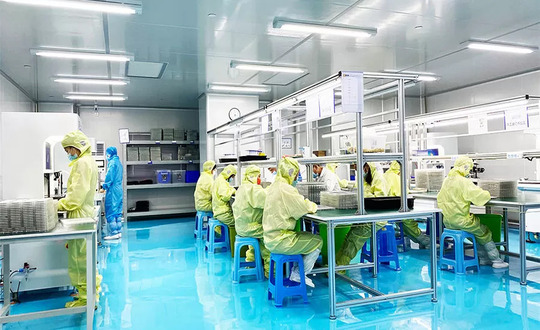
The ultimate goal of R&D is mass production. With 20+ years of manufacturing experience, automated production lines, and a complete supply chain system, HOTHMI has established a full-chain mass production assurance system covering raw material supply, production scheduling, quality control, and cost management, ensuring that new display R&D results are smoothly transformed into mass-produced products.
Raw Materials: Build a Stable Supply Chain for Continuous and Timely Supply
Display raw materials include LCD panels, IC chips, backlight modules, touch panels, optical adhesives, etc. The stability of raw material supply directly determines mass production efficiency. HOTHMI’s key assurance measures include:
- Strategic cooperation for core raw materials: Establish long-term strategic partnerships with suppliers of core raw materials such as LCD panels and IC chips to secure supply share and ensure continuous material supply.
- Multi-supplier strategy: For key components, qualify 2-3 approved suppliers to avoid single-source supply disruption risks, while also reducing procurement costs through supplier competition.
- Raw material inventory management: Based on mass production plans, establish reasonable safety stock levels for raw materials. For customized materials, place orders in advance to maintain production rhythm.
- Raw material quality control: Develop incoming quality control (IQC) standards for raw materials. All materials must pass inspection before entering the warehouse to ensure quality meets mass production requirements.
Production Workshop: Scientific Scheduling to Optimize Order Sequence
HOTHMI has professional LCD, TFT, and OLED production lines. The production workshop must scientifically arrange order sequences based on order priority, product type, and production efficiency:
- Order sequencing: Optimize the production order based on order placement time and material arrival schedules.
- Concentrated production by product type: Concentrate production of the same type and process to reduce line changeover time and improve efficiency.For example, all circular screens are produced on the irregular screen line, and all standard TFT screens on the automated line.
- Capacity matching: Allocate orders reasonably according to each line’s capacity and yield rate, avoiding overload and ensuring product quality.
Quality Control: Full-Process Management to Ensure Mass Production Consistency
Quality is the core competitiveness of the enterprise. HOTHMI always adheres to the “quality first” philosophy, establishing a full-process quality control system from R&D to mass production to ensure performance consistency and stability of new display mass production:
- R&D stage: Develop detailed product quality standards, integrate quality requirements into the design, and avoid design defects that could cause quality issues.
- Pilot production stage: During small-batch pilot production, track production processes, record quality data, optimize process parameters, resolve quality problems, and form mass production process standards.
- Mass production stage: Implement first-article inspection, patrol inspection, and final quality control (FQC). Use automated testing equipment to check core parameters, ensuring products meet quality standards. For industrial-grade products, add environmental reliability tests to guarantee quality stability in complex scenarios.
- After-sales stage: Establish a quality traceability system, recording production and test data for each batch. Quickly identify root causes of after-sales quality issues and optimize R&D and production processes.
Cost Management: Full-Dimension Optimization to Control R&D and Production Costs
Cost management during the mass production stage directly determines product market competitiveness. HOTHMI optimizes costs across three dimensions: R&D, production, and supply chain, controlling the overall cost of new displays:
- R&D cost management: Use modular design to reuse existing mature technologies and components, reducing investment in completely new designs. Validate technical feasibility through small-batch testing to avoid cost waste from large-scale R&D errors.
- Production cost management: Optimize production processes, increase the proportion of automation to reduce labor costs. Improve production yield to reduce defect rates and raw material waste. Arrange production schedules reasonably to improve line utilization and reduce fixed costs per unit.
- Supply chain cost management: Reduce raw material procurement costs through volume purchasing (order quantity plus buffer stock) and strategic cooperation. Optimize logistics to reduce transportation costs for raw materials and finished products. Establish an inventory alert system to avoid capital tie-up from excess stock.
LCD Module Mold Opening Process: Standardized Procedures to Ensure Accuracy and Efficiency
LCD module mold opening is a critical step in new display mass production, directly determining the panel’s appearance, structure, and assembly precision. Leveraging 20+ years of mold opening and manufacturing experience, HOTHMI has developed a standardized, full-process LCD module mold opening procedure covering five core stages: pre-mold preparation, mold design, mold machining, mold trials and rework, and mold acceptance, ensuring quality and efficiency.
Pre-Mold Preparation: Precise Alignment to Define Mold Requirements
- Technical parameter confirmation: R&D engineers provide detailed technical drawings of the new display LCD module, defining core parameters such as module size, structure, interface position, and mounting method, as well as precision requirements (e.g., customized structural requirements for irregular or circular screens).
- Mold requirement communication: R&D, production, and the mold manufacturer jointly communicate to define mold material (e.g., plastic, metal), mold type (e.g., injection mold, stamping mold), and mold lifespan requirements corresponding to mass production volume.
- Mold cost and cycle calculation: Confirm mold opening cost and lead time with the mold manufacturer, develop a mold opening plan that matches the overall mass production schedule.
Mold Design: Precisely Design Mold Structure Based on Mass Production Needs
- Structural design: The mold manufacturer designs according to the technical drawings, ensuring the mold structure matches the LCD module’s manufacturing process. For customized modules (e.g., circular, irregular), non-standard mold structures are used.
- Mass production adaptation design: Based on forecast order volumes, design the mold’s service life. For large-batch mass production, use high-hardness mold materials to improve durability. For small-batch customization, use flexible mold designs to reduce mold opening costs.
- Design review: HOTHMI’s R&D and production teams review the mold design drawings, verifying structural rationality, assembly precision, and mass production suitability, providing modification suggestions to ensure no design deviations.
Mold Machining: High-Precision Processing to Ensure Mold Accuracy
- Raw material blanking: Based on the mold design drawings, select the corresponding mold steel material and perform blanking to determine raw material dimensions for components such as cavity blocks, core blocks, and inserts.
- Rough and finish machining: Use CNC milling, milling machines, and other equipment for rough machining to form the mold blank. Then use high-precision equipment such as engraving, wire EDM, and sinker EDM for finish machining, ensuring cavity and core dimensional accuracy to ±0.005mm, matching the high-precision requirements of LCD modules.
- Mold component machining: Machine and assemble components such as ejector pins, guide pillars, cooling channels, and gates, ensuring compatibility with the main mold body.
- Mold heat treatment: Perform heat treatment such as quenching and nitriding on critical mold components to enhance hardness, wear resistance, and service life, adapting to the high-intensity demands of mass production.
Mold Trials and Rework: Repeated Debugging to Optimize Mold Performance
- First mold trial: Install the machined mold on an injection molding machine, use the raw materials planned for mass production to perform the first trial, producing a small number of sample modules.
- Sample inspection: The R&D and quality teams perform full-dimension inspection on the trial samples, including dimensional accuracy, structural assembly, and appearance quality. Compare with the design drawings to identify mold issues (e.g., dimensional deviation, edge burrs, uneven bonding).
- Mold rework: The mold manufacturer reworks the mold based on sample inspection results, adjusting cavity and core dimensions, optimizing gate and ejector pin positions, and resolving issues found during the trial.
- Repeated mold trials and rework: Repeat the trial-inspect-rework cycle until the trial samples fully meet design standards and quality requirements, ensuring the mold is ready for mass production.
Mold Acceptance and Mass Production: Strict Acceptance, Handover for Production
- Mold acceptance: HOTHMI organizes R&D, production, and quality teams for formal mold acceptance. Acceptance items include mold precision, structural stability, trial sample yield rate, and mold service life. After acceptance, sign the acceptance report.
- Mold handover: The mold manufacturer delivers the accepted mold to HOTHMI’s production workshop, along with drawings, instruction manuals, and maintenance guides.
- Mass production commissioning: The production team installs the mold on the production line, performs process debugging before mass production, optimizes injection molding/stamping parameters, ensures production efficiency and yield for LCD modules, and formally enters mass production.
- Mold maintenance: Establish a regular mold maintenance and care system, including cleaning, lubrication, and inspection. Address mold failures promptly to extend mold life and ensure mass production continuity.
Conclusion
New display engineering is the core implementation vehicle of HOTHMI’s “focus on R&D, strong innovation” philosophy. From precise confirmation of technical parameters to in-depth preliminary research, from full-chain mass production assurance to standardized LCD module mold opening procedures, every step relies on the company’s 20+ years of R&D and manufacturing experience, professional engineering team, and complete supply chain system. HOTHMI always takes market demand as the guide and technological innovation as the core, deeply integrating R&D with mass production. This approach ensures both technical advancement and product competitiveness of new displays while achieving efficient industrialization of R&D results, providing customized, high-quality display solutions for customers worldwide, and continuously consolidating its industry position as a leading industrial-grade display manufacturer.