Detailed Explanation of MIPI Interface and DSI Display Specification
Introduction to MIPI: The Universal Language Inside Mobile Devices
In the precise world of mobile devices, core components—such as processors, displays, and cameras—need to communicate efficiently. To achieve this, MIPI was developed. It is a set of communication interface standards designed specifically for mobile devices (including smartphones, tablets, digital cameras, displays, radio systems, and IoT devices) to meet their strict demands for high bandwidth, low power consumption, and low electromagnetic interference.
The MIPI Alliance initiated these standards in 2003. Its founding members included industry giants such as ARM, Intel, Nokia, Samsung, and Texas Instruments. The core goal was to establish unified, universal standards to reduce design complexity and ensure seamless integration and interoperability among components from different manufacturers, thereby accelerating design efficiency across the entire industry.
The MIPI standards possess several key characteristics: they provide standardized interconnection solutions for various mobile components, ensuring excellent versatility; their design is highly efficient, focusing particularly on balancing power consumption with data transmission rates; and they offer exceptional scalability, adapting to current diverse device forms while leaving room for future technology upgrades.
Focus on MIPI DSI: The Dedicated Channel for Displays
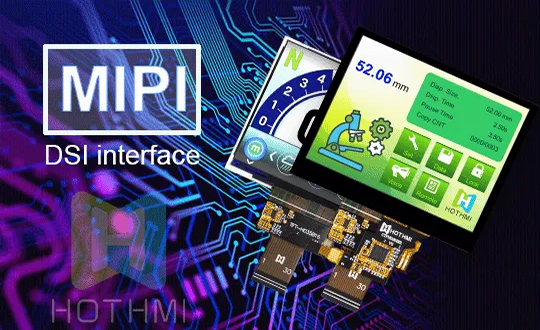
Among the many sub-specifications of MIPI, MIPI DSI is the core standard dedicated to communication between display modules and processors. It supports high-speed data transmission up to 6 Gbps, enabling modern high-density screens (such as those on smartphones and gaming handhelds) to present high-resolution, zero-latency, and exquisite visual imagery.
To meet diverse display needs, the DSI interface natively supports mainstream color formats like RGB-565, RGB-666, and RGB-888. Developers can flexibly select formats based on application scenarios—for instance, using RGB-888 for ultimate color accuracy, or RGB-565 to achieve higher transmission efficiency.
Additionally, the DSI interface integrates power-saving technologies to extend device battery life. Its standardized design ensures broad compatibility across different devices. By utilizing differential signaling and multi-lane architectures, it effectively suppresses EMI while achieving linear bandwidth scaling, providing a solid foundation for advanced display technologies.
Core Advantages of MIPI DSI at a Glance
- Ultra-High Speed: Delivers data throughput up to 6 Gbps to effortlessly handle high-resolution, high-refresh-rate video streams and images.
- Universal Adaptability: Fully compatible with current mainstream display panel technologies, including OLED and LCD.
- Unified Standards: Simplifies the design and development processes for manufacturers, reducing integration risks.
- Bandwidth Scalability: Supports multi-lane configurations to scale total bandwidth on demand, which is ideal for ultra-high-resolution scenarios.
- Robust Signaling: Employs differential signaling to resist common-mode interference, ensuring clear and stable display output.
- Power Optimization: Deeply optimized for mobile devices to reduce display subsystem energy consumption and extend battery life.
- EMI Friendliness: Features low electromagnetic radiation characteristics, minimizing interference with other wireless RF and sensitive components.
- High Flexibility: Easily adapts to various screen resolutions and technologies, spanning from low-end to high-end and small to large sizes.
- Reliable Transmission: Built-in error detection and correction mechanisms (ECC/Checksum) safeguard data integrity, preventing image tearing or artifacts.
Technical Deep Dive: Power, Packets, and Operating Modes
Power Interface Voltage Levels: Three-Tier Power Management
- High-Speed Mode: The full-throttle state where data lanes and backlights are fully active. Designed for high-load scenarios like video and gaming, it delivers a bandwidth of up to 6 Gbps but consumes relatively more power.
- Low-Power Mode: In this mode, data lanes are turned off to save electricity, but the backlight remains on. It is suitable for displaying static images or standby interfaces, significantly extending battery life and reducing heat generation.
- Ultra-Low Power State: Specifically designed for periods when the screen has no content updates for a long time or is turned off. It minimizes power consumption to improve overall thermal performance and long-term device reliability.
Packet Structure: Short Packets and Long Packets
- Short Packets: Ranging from 2 to 9 bytes in length, these are primarily used to transmit control commands, such as brightness adjustment, color inversion, and display sleep/wake triggers. The packet tail includes an 8-bit Error Correction Code (ECC) to guarantee accurate command delivery.
- Long Packets: Ranging from 6 bytes up to a maximum of 65,541 bytes, these carry actual image pixel data or complex, multi-byte instructions. The packet tail utilizes a 16-bit Checksum to ensure the integrity of large data blocks.
Operating Modes: Command Mode and Video Mode
- Command Mode: Suitable for low-power scenarios or situations where screen content changes infrequently. The processor sends update instructions in a “command + data” packet format. The display’s built-in RAM stores the frame data, eliminating the need for continuous refreshing and effectively saving power.
- Video Mode: Specifically designed for real-time streaming video. The processor continuously transmits pixel data streams to the display to guarantee smooth dynamic visuals and instant responsiveness. This is the preferred mode for high-performance video playback and gaming.
Conclusion
In summary, the MIPI DSI specification revolutionizes display communication in mobile devices by integrating high-speed data transmission, multi-level power management, flexible lane scaling, and reliable error correction mechanisms. It provides developers with an ideal platform that delivers stunning visual experiences while maintaining responsive interaction and long-lasting battery life. It stands as a critical technological cornerstone for building modern mobile products.