High-Cost-Performance 2.8 inch Industrial TFT Display Module – TFT-H028A26QVTST3N14
In application fields such as light-duty smart terminals, industrial human-machine interface panels, portable inspection devices, and compact medical instruments, small-size color screens serve as the core component for data visualization and human-machine interaction. However, development teams often encounter challenges including insufficient microcontroller I/O pins, limited internal device space, wide temperature fluctuations, and strong electromagnetic interference. These issues make it difficult for traditional parallel-interface large screens to meet the requirements for lightweight design, high reliability, and low-cost development.
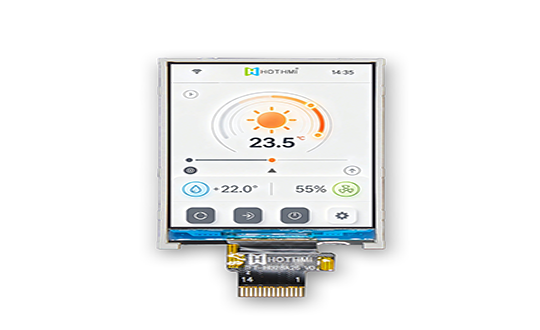
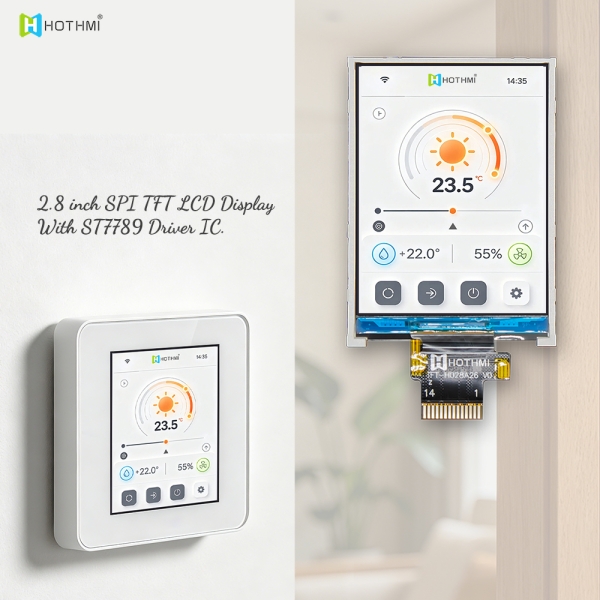
The TFT-H028A26QVTST3N14 2.8-inch color LCD display module, introduced by HOTHMI, is specifically designed to address these pain points. It incorporates the ST7789 dedicated driver chip, communicates via a 4-wire SPI serial interface, and integrates multiple industrial-grade features such as wide-temperature operation, 8kV electrostatic discharge protection, high-brightness display, ultra-slim compact construction, and reinforced flexible cable. This combination delivers both development convenience and environmental robustness, making it a high-cost-performance display choice for resource-constrained systems.
I. Hardware Specifications and Display Performance
Dimensions and Structure
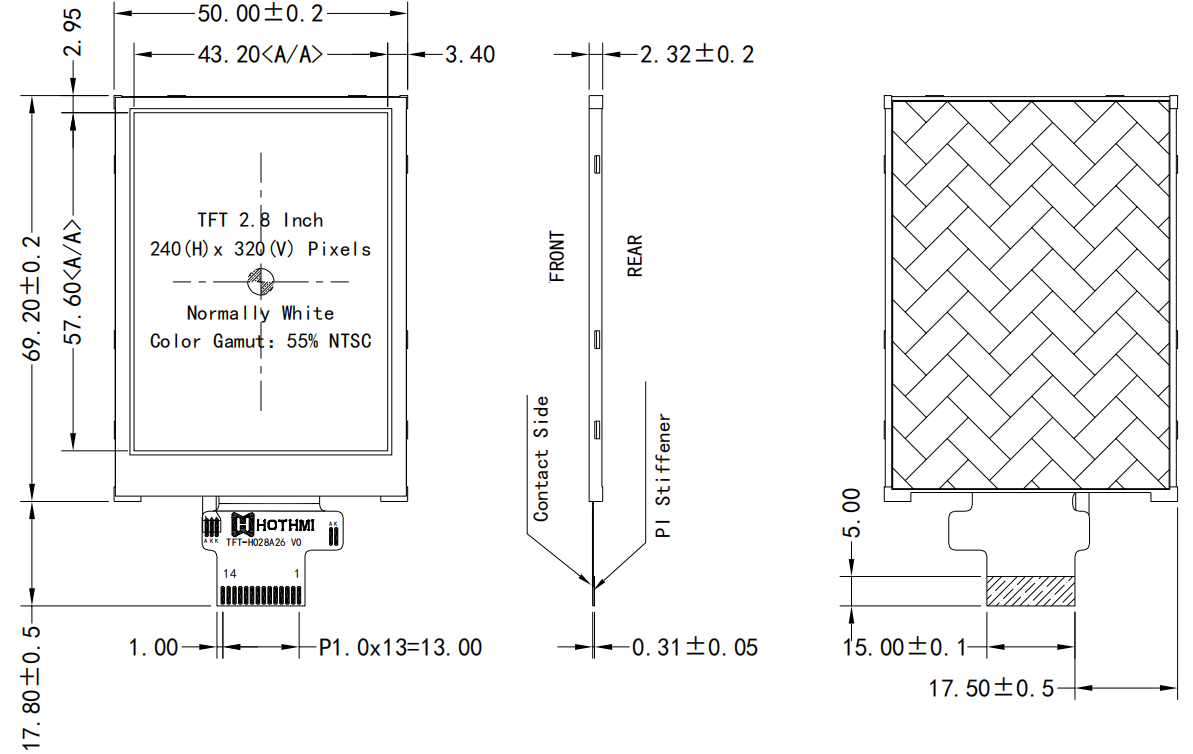
This product is an integrated color LCD module with an overall length of 50mm, width of 69.2mm, and a thickness of just 2.32mm. The ultra-slim design effectively saves valuable internal space in handheld devices or compact instruments, leaving more room for batteries and other components. The active display area measures 43.2mm in length and 57.6mm in width, conforming to the standard 2.8-inch human-machine interaction window size.
Signal transmission is accomplished via a 14-pin flexible flat cable with 1.0mm pitch. The gold-plated contact fingers are reinforced with polyimide material, achieving a thickness of 0.31mm. This significantly enhances tensile strength and flex resistance, effectively preventing poor contact or breakage during mass assembly and debugging, thereby reducing product return rates.
Display and Optical Performance
- Panel Type: Twisted Nematic liquid crystal with normally white display mode, achieving color saturation of 55% of the NTSC standard. The color reproduction is full and uniform, allowing text, icons, and curves to be clearly presented.
- Resolution: 240×320 pixels in vertical arrangement, sufficient to display equipment parameters, waveform charts, menu options, status indicators, and other rich content.
- Backlight Brightness: Uses an LED constant-current backlight with an operating voltage of 3.0V (±0.3V), current of 80mA, and typical brightness of 300 cd/m². The optimized light-guide plate design reduces ambient light reflection, ensuring readability in both indoor and semi-outdoor lighting conditions.
- Viewing Angles: Typical viewing angles are 50° (up), 20° (down), 45° (right), and 45° (left), suitable for normal viewing angles of handheld or wall-mounted devices.
- Power Supply Requirement: The entire module requires only a single 3.0V (±0.3V) power supply, simplifying power circuit design and making it convenient for use with lithium batteries or low-voltage DC power sources.
Driver and Communication Interface
The module is built with the mature ST7789 display driver IC, which natively supports the 4-wire SPI serial bus. Compared with traditional 8-bit or 16-bit parallel interfaces, it requires only four signal lines—clock, data, chip select, and command/data toggle—to complete image and command transmission, resulting in extremely simple hardware connections.
| Category | Item | Specification |
| Physical Dimensions | Module Outline | 50mm × 69.2mm |
| Active Area | 43.2mm × 57.6mm | |
| Module Thickness | 2.32mm | |
| FPC Specification | 14-Pin, 1.0mm Pitch | |
| Optical Display Parameters | Resolution | 240(H) × 320(V) |
| Panel Technology | TN, Normally White | |
| Typical Brightness | 300 cd/m² | |
| NTSC Color Gamut | 55% | |
| Electrical Power Parameters | Operating Voltage | 3.0 ± 0.3V |
| Backlight Voltage | 3.0 ± 0.3V | |
| Backlight Current | 80mA | |
| Communication Interface | 4-Wire SPI (ST7789) | |
| Industrial Environment Parameters | Operating Temperature | -20℃ ~ +70℃ |
| Storage Temperature | -30℃ ~ +80℃ | |
| ESD Protection | 8kV | |
| Viewing Angle | U50 / D20 / R45 / L45 |
II. Advantages of the 4-Wire SPI Serial Interface
Compared with parallel interfaces, the 4-wire SPI offers significant advantages in multiple aspects, making it particularly suitable for small-to-medium-size screens:
Hardware Level: Parallel interfaces often require 8 to 16 data lines plus multiple control lines, consuming a large number of microcontroller I/O pins. In contrast, 4-wire SPI uses only 4 general-purpose pins, freeing up valuable pin resources for other peripherals such as sensors, buttons, and communication modules. Meanwhile, the reduced number of signal lines simplifies PCB routing, lowers signal interference, and reduces board area, helping to cut material and processing costs.
Development Level: SPI is a universal synchronous serial communication protocol. Almost all mainstream microcontrollers (such as STM32 series, ESP32 series, 8051, Arduino, FPGA, etc.) have built-in SPI hardware modules. Combined with the rich open-source driver code available for the ST7789 chip, developers do not need to write complex low-level timing from scratch, making software porting very fast. For 240×320 resolution screens, the 4-wire SPI can fully support smooth parameter refreshing, interface switching, and simple animation displays.
Power Consumption: The SPI bus supports on-demand wake-up. When the screen content is not being updated, data transmission can be halted. Together with the driver chip’s built-in sleep mode and adjustable backlight levels, the overall static power consumption is extremely low. This is particularly beneficial for battery-powered handheld detectors or portable medical devices, effectively extending the operating time per charge.
Expansion Capability: The SPI bus supports a master-slave topology. Multiple devices—including this display module, data storage chips, touch controllers, or analog-to-digital converters—can be connected on the same bus without requiring additional dedicated pins, thereby improving overall system integration.
III. Industrial-Grade High-Reliability Features
Wide-Temperature Operation: The module uses industrial-grade LCD materials and temperature-resistant components. Its operating temperature range covers -20°C to +70°C, allowing stable operation in cold outdoor environments, high-temperature equipment rooms, or production-line control cabinets with severe temperature fluctuations. The storage temperature range extends from -30°C to +80°C, ensuring the screen remains safe during warehousing and transportation.
Electrostatic Discharge Protection: In industrial sites, handheld devices, and power monitoring scenarios, static electricity and pulse interference often cause screen flickering, black screens, or even driver damage. This module’s circuit design integrates up to 8kV ESD protection capability. Combined with a stable 3.3V drive circuit, it effectively resists electrostatic shocks from human contact or equipment friction, reducing on-site failure rates.
High-Brightness Backlight: The standard brightness of 300 cd/m², paired with the optimized light-guide structure, ensures that digits, alarm indicators, and waveform curves remain clearly visible under strong reflective conditions such as factory ceiling lights or natural light from windows. No additional sunshade or hood is required, simplifying the device enclosure design.
Reinforced Flexible Cable: Ordinary flexible cables have thin gold-plated contacts that are prone to fracture during bending. This module comes standard with a polyimide-reinforced cable, featuring a thicker protective layer over the contacts. Its tensile strength and resistance to repeated bending are significantly improved, making it compatible with both automated SMT and manual assembly processes, thereby reducing production losses and post-sale contact-related issues.
IV. Typical Application Areas
Leveraging its ultra-slim structure, simple 4-wire SPI connection, wide-temperature and anti-static performance, and low power consumption, this module is widely applicable in the following fields:
Industrial Smart Control: Suitable for HMI panels on automated production lines, power monitoring instruments, environmental monitoring controllers, and small inverter operator panels. The wide-temperature and anti-static characteristics meet the demanding requirements of factories with high temperatures, dust, and frequent static discharge, enabling long-term stable display of operating parameters and alarm messages.
Handheld Portable Inspection: Examples include infrared thermometers, gas analyzers, barcode scanners, and water quality testing instruments. The 2.32mm ultra-thin body leaves more space for larger batteries, while the reduced pin count simplifies main control board layout, and low power consumption extends the operating time during field inspections.
Smart Home and IoT: Can be used in smart wall switch panels, indoor temperature and humidity displays, small appliance control interfaces, and IoT data collection terminals. The standard SPI driver quickly adapts to various IoT main control chips, the slim appearance facilitates installation, and the wide-temperature design suits indoor environments with seasonal temperature variations.
Portable Medical Assistance: Suitable for electronic blood pressure monitors, fingertip pulse oximeters, and compact in-vitro diagnostic analyzers. The normally white panel offers good contrast, clearly and softly displaying vital sign values and waveform curves. The low-voltage and low-power design meets the lightweight and high-stability requirements of medical devices.
V. Frequently Asked Questions
Q: Can this 2.8-inch SPI display be used in industrial or semi-outdoor environments?
A: Absolutely. It features an operating temperature range of -20°C to +70°C, 8kV ESD protection, and 300 cd/m² high-brightness backlight, enabling stable operation in factory production lines, power equipment rooms, and outdoor handheld devices. If full-day direct sunlight exposure is expected, optional anti-glare or higher-brightness custom versions are available.
Q: Is development with the 4-wire SPI more difficult than with a parallel interface?
A: On the contrary, it is easier. The ST7789 driver chip has complete open-source library support. The 4-wire SPI timing logic is simple, and the microcontroller’s hardware SPI module automatically handles clock synchronization, eliminating the need for software-emulated complex parallel timing. Fewer connections also reduce the chance of soldering and debugging errors, helping to shorten the overall development cycle.
Q: Does the 2.32mm ultra-thin thickness compromise the screen’s structural robustness?
A: Not at all. The liquid crystal layer and backlight module are integrated with reinforced packaging, and the flexible cable is also strengthened. The entire assembly has passed bending and drop reliability tests. The ultra-thin design is merely a dimensional advantage; the internal core components still maintain industrial-grade protection standards, achieving both slimness and durability.
VI. Summary
The TFT-H028A26QVTST3N14 2.8-inch LCD display module, built upon the mature ST7789 driver solution and the simple 4-wire SPI communication architecture, also incorporates industrial-grade designs including wide-temperature operation, high ESD protection, high brightness, low power consumption, and reinforced cabling. It effectively resolves common challenges in small-device development, such as insufficient I/O pins, space limitations, harsh environments, high production defect rates, and poor battery life.
From development efficiency and production cost control to long-term operational reliability, this module provides a mature, easily implementable, and cost-effective standardized solution for small-size display needs in industrial instruments, handheld inspection terminals, compact medical devices, and IoT smart panels. It stands as an ideal display choice for lightweight human-machine interaction systems.