Description
Product Overview
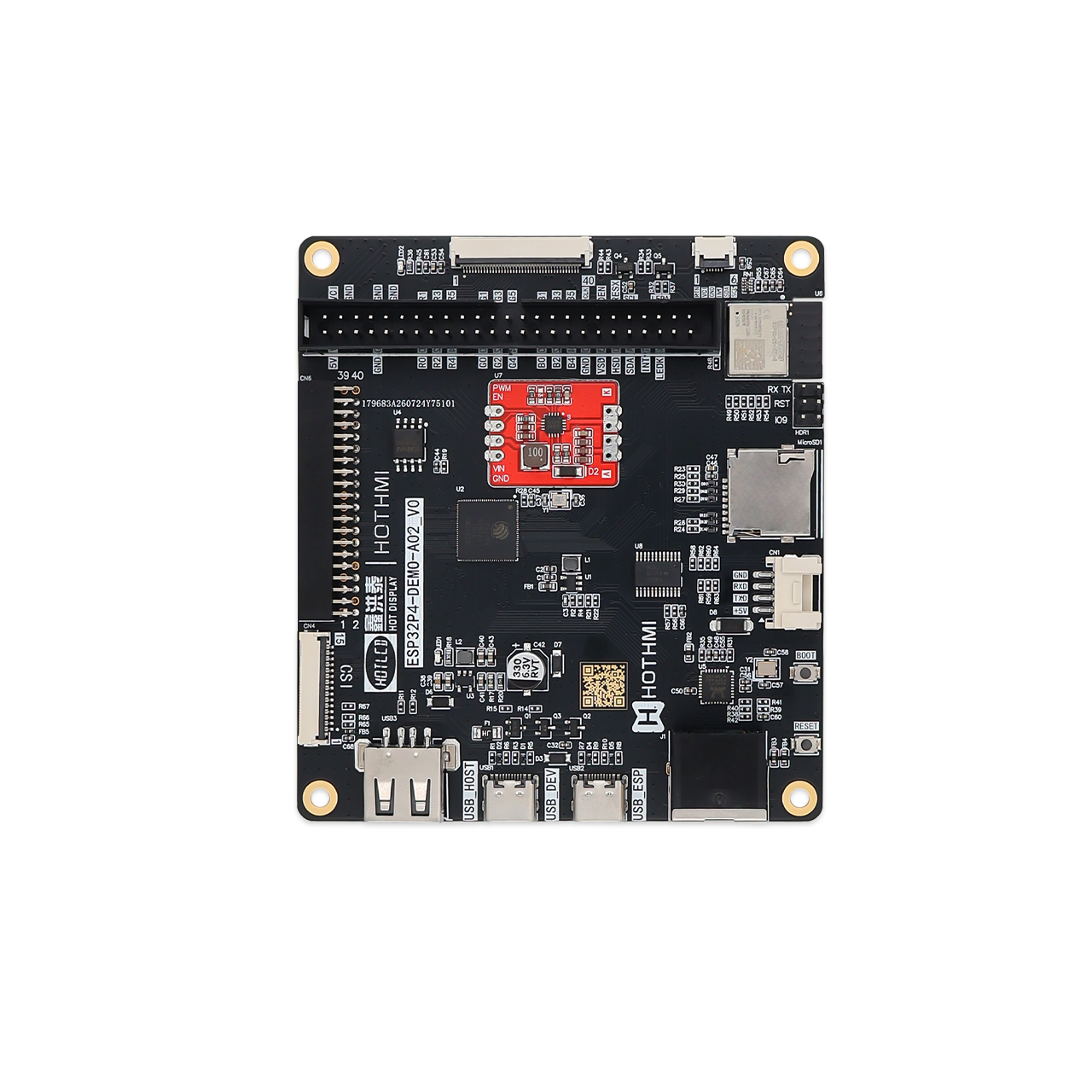
The ESP32P4-DEMO-A02 is a versatile ESP32-P4 development board designed for embedded system development, hardware evaluation, human-machine interface (HMI) development, and product prototyping. Based on the powerful ESP32-P4 platform, this development board integrates a wide range of display, USB, storage, serial communication, and expansion interfaces to support flexible hardware development and peripheral integration.
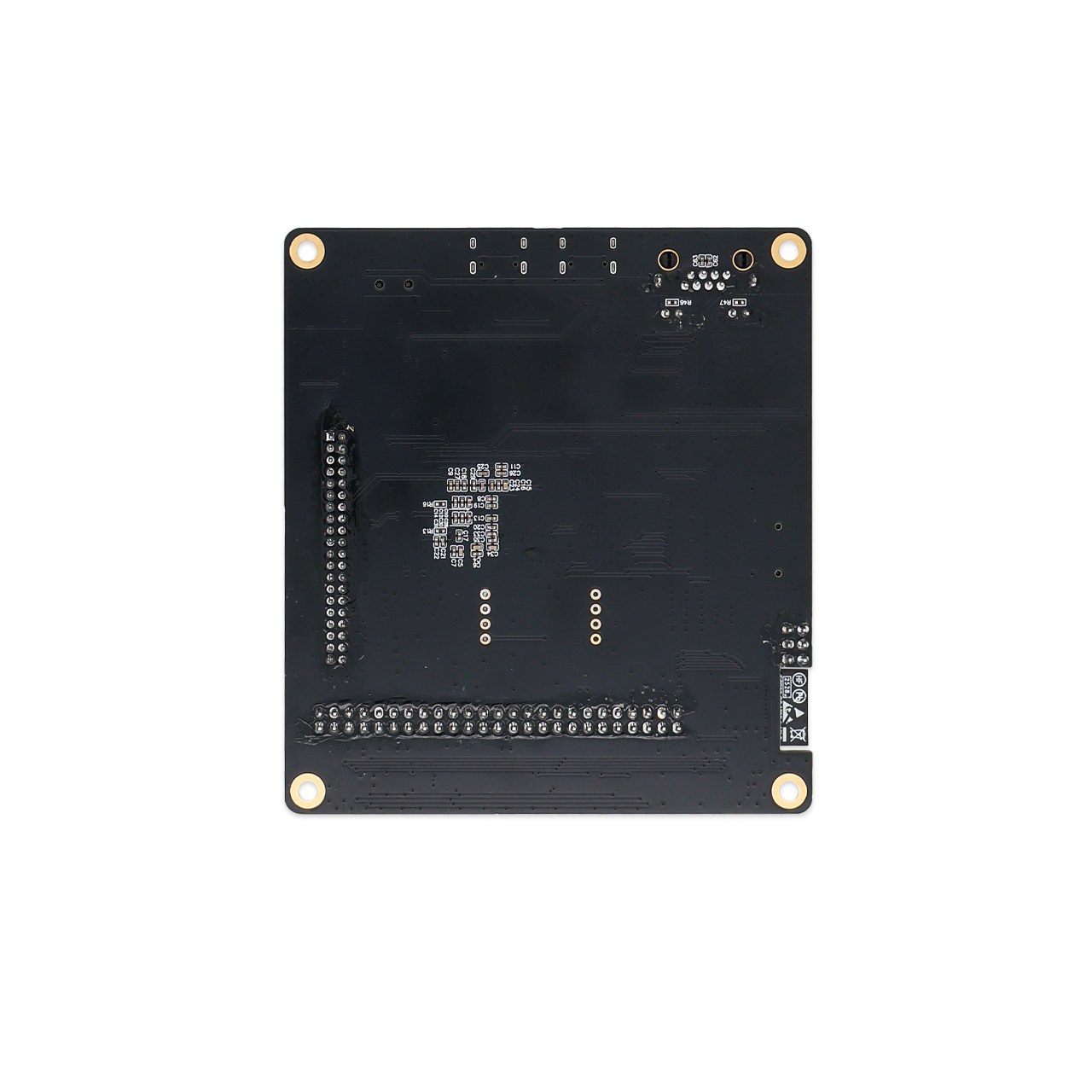
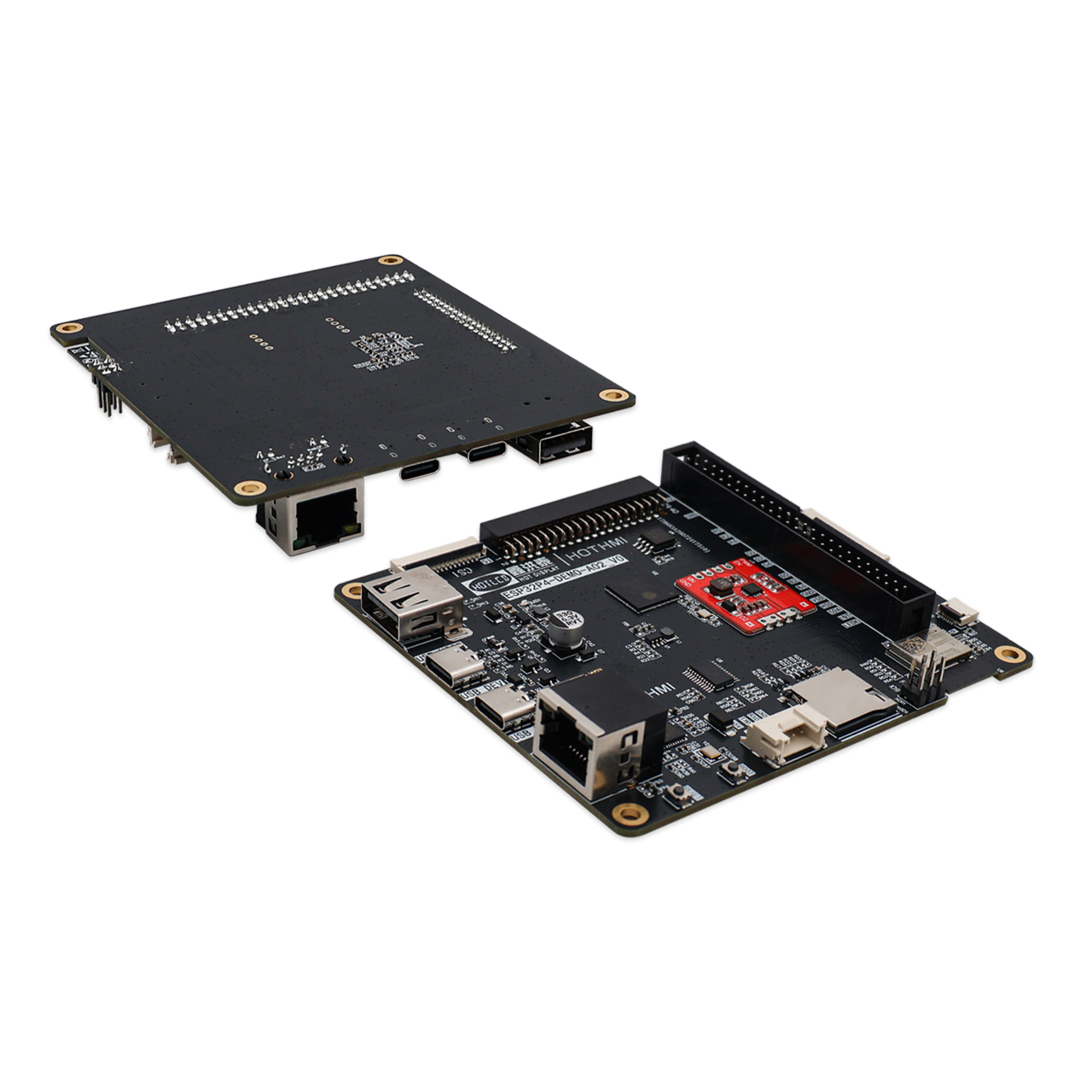
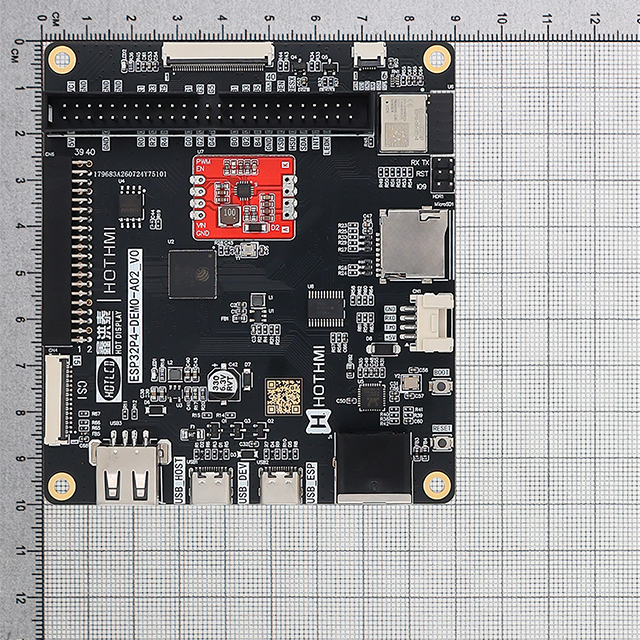
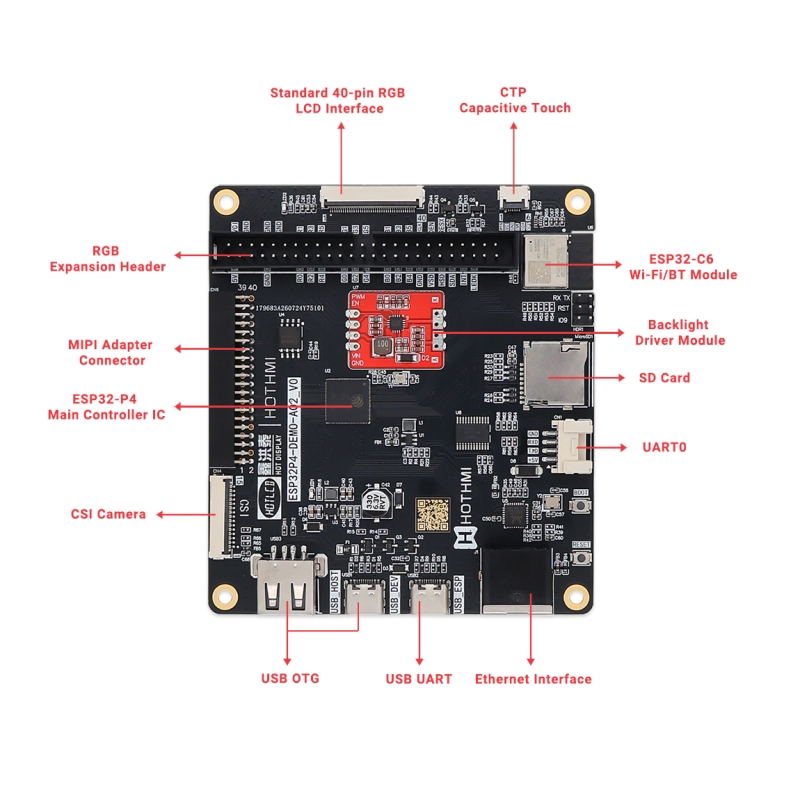
The board features a compact PCB design with an extensive selection of onboard interfaces, including MIPI DSI (CSI) display/camera interfaces, a dedicated CS1 interface, MicroSD card slot, multiple USB interfaces, a 40-Pin expansion header, serial debugging interface, RESET and BOOT buttons, and status indicator LEDs. These features make the ESP32-P4 development board suitable for a wide range of embedded and interactive device development applications.
Key Features
- Comprehensive Multimedia Interfaces:The ESP32-P4 development board provides MIPI DSI (CSI) display/camera interfaces and an independent CS1 interface. Combined with the LEDA/LEDK backlight drive circuit, these interfaces provide flexible connectivity for various industrial and consumer display applications.
- Flexible USB Interface Architecture:The ESP32-P4 development board features a comprehensive USB interface configuration, including USB_HOST, USB_DEV, and USB_ESP interfaces. This allows the board to support different connection requirements for host devices, peripherals, programming, and debugging.
- High-Speed Local Storage:An integrated MicroSD card slot provides convenient local storage for data logging, multimedia resources, configuration files, and other application data, making the board suitable for embedded multimedia and data-processing applications.Reliable Power Supply Design:The board integrates an independent MOD-B6903 power conversion module, supporting PWM, EN, VIN, and GND connections. It is also equipped with a large-capacity 330 6.3V RVT solid capacitor, helping provide stable power delivery during high-load multimedia and embedded applications.
- Convenient HMI and Expansion Interfaces:A 40-Pin dual-row expansion header provides access to commonly used signals, including TXD, RXD, IO9, RST, +5V, and GND. The board also features dedicated RESET and BOOT physical buttons, allowing developers to perform hardware reset and enter download mode conveniently during development and debugging.
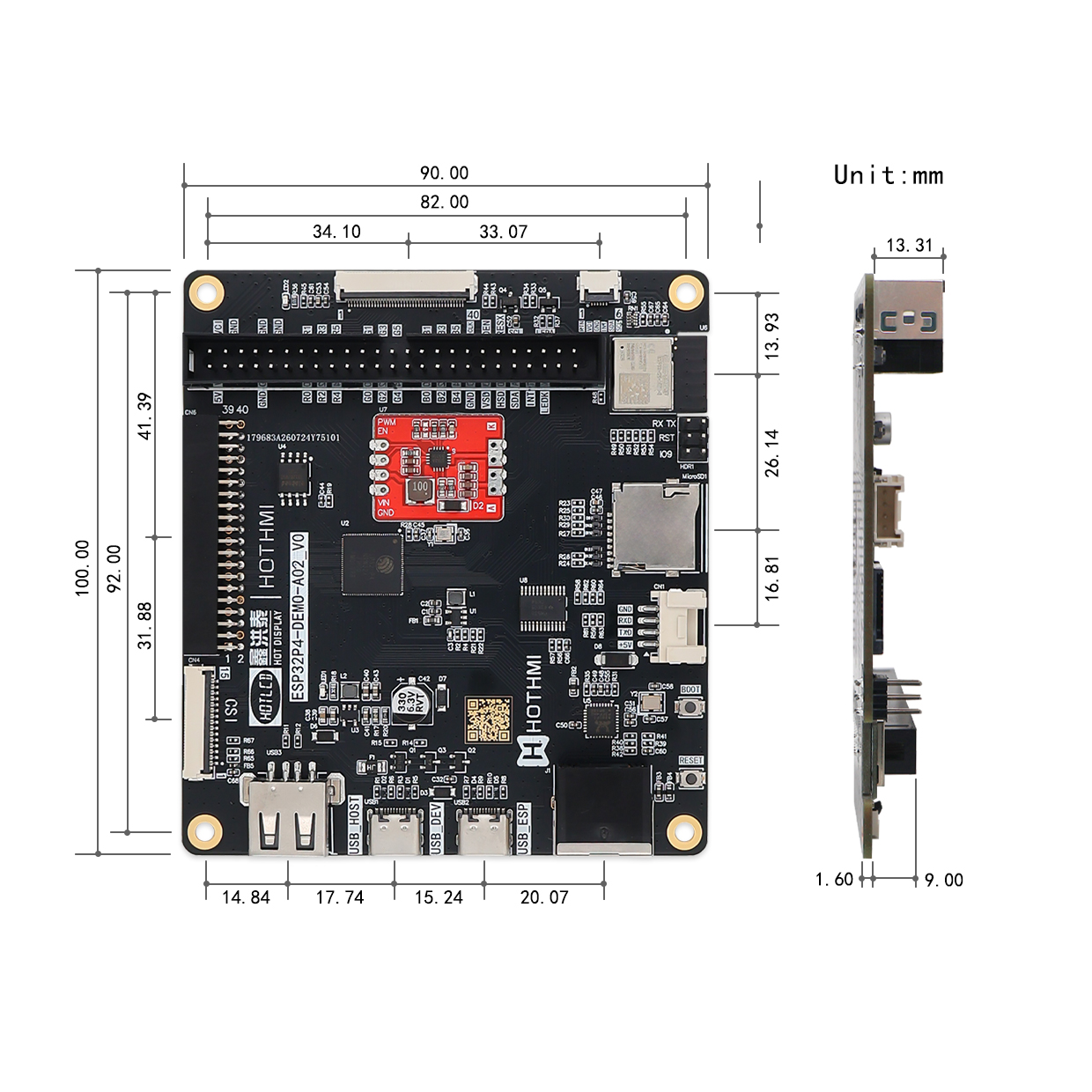
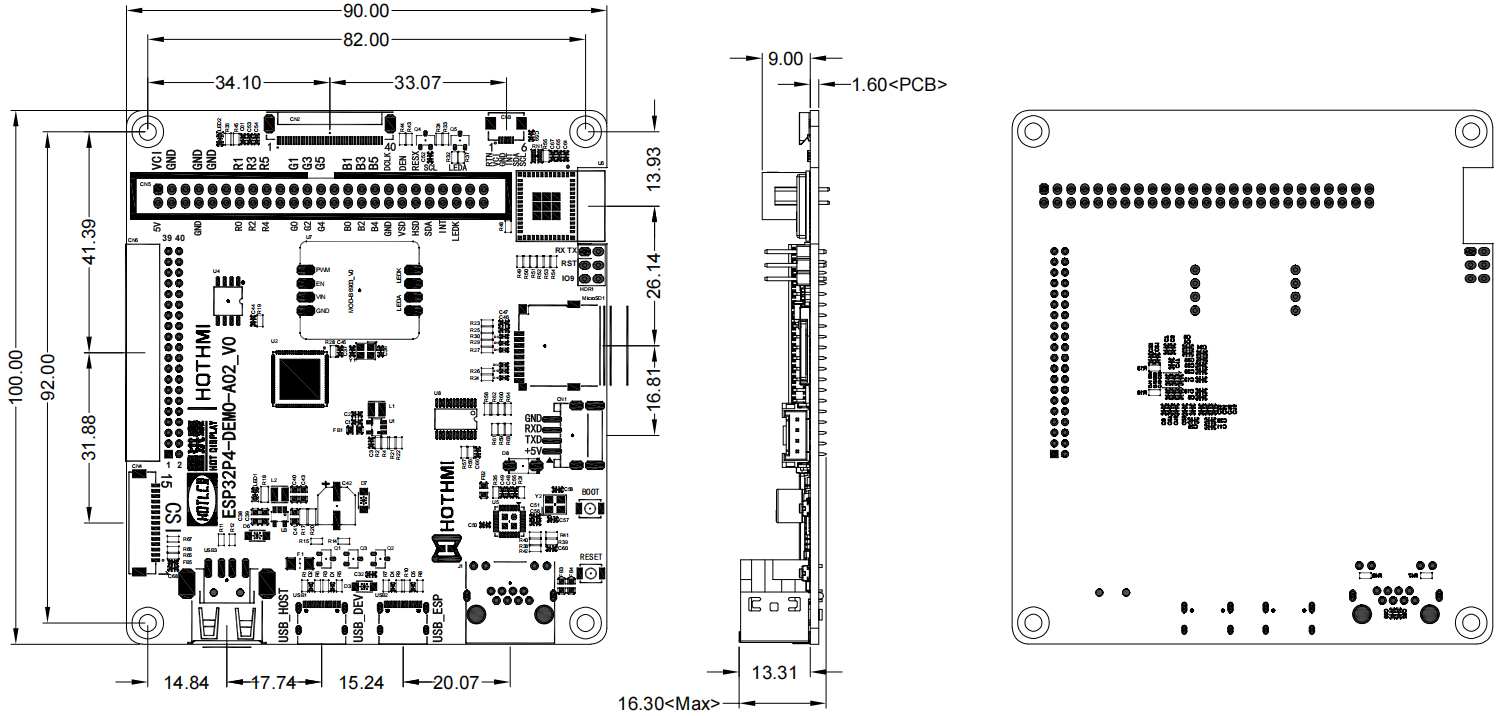
- Compact and Practical PCB Design:The PCB measures 100.00 mm × 90.00 mm, with a PCB thickness of 1.60 mm and a maximum component height of 16.30 mm. Standard mounting holes are reserved at the four corners, making the board convenient for integration into enclosures and embedded hardware prototypes.
Mechanical Structure and Physical Dimensions
The ESP32-P4 development board adopts a compact PCB layout designed for embedded system development, product prototyping, hardware evaluation, and peripheral integration.
| Parameter | Specification |
|---|---|
| Product Model | ESP32P4-DEMO-A02 |
| PCB Dimensions | 100.00 mm × 90.00 mm |
| PCB Thickness | 1.60 mm |
| Maximum Component Height | 16.30 mm Max |
| Dimensional Tolerance | ±0.3 mm |
| Drawing Scale | 1:1 |
Typical Applications
As a high-performance ESP32-P4 development board, the ESP32P4-DEMO-A02 can be used in a variety of embedded and interactive applications.
- Smart Home and HMI:The board can be used to develop smart home control panels, intelligent device interfaces, HMI terminals, and embedded interactive prototypes, particularly for applications requiring display and user interaction.
- IoT Devices and Edge Applications:With its rich peripheral interfaces, USB connectivity, storage capability, and expansion headers, the board is suitable for IoT terminals, data acquisition devices, edge computing prototypes, and embedded hardware evaluation.
- Multimedia and Display Terminals:The combination of display interfaces, MicroSD storage, and USB connectivity makes the board suitable for developing graphical user interfaces, multimedia terminals, interactive displays, and embedded display applications.
- Industrial Control and Embedded Systems:The ESP32-P4 development board can also be used for industrial data display terminals, data acquisition systems, embedded controllers, and hardware proof-of-concept development.
Technical FAQ
Q1: What key debugging and control signals are available on the 40-Pin expansion interface?
A: The 40-Pin expansion interface provides commonly used debugging, communication, power, and control signals, including +5V, GND, TXD, RXD, IO9, and RST. These signals make it convenient to perform serial communication and connect external peripherals during development.
Q2: What are the physical dimensions and space requirements of the ESP32-P4 development board?
A: According to the official mechanical drawing, the PCB measures 100.00 mm × 90.00 mm. The PCB thickness is 1.60 mm, while the maximum component height is 16.30 mm. The dimensional tolerance is ±0.3 mm.
Q3: What physical buttons and indicator LEDs are provided for debugging?
A: The board includes dedicated RESET and BOOT buttons. The RESET button is used for hardware reset, while the BOOT button can be used to enter download mode. The board also includes status indicator LEDs such as LED1 and LED2, along with dedicated TX/RX serial communication indicators, providing visual feedback during development and debugging.
Conclusion
The ESP32P4-DEMO-A02 ESP32-P4 development board combines a powerful ESP32-P4 platform with flexible display, USB, storage, serial communication, and expansion interfaces. Its compact PCB design and comprehensive peripheral configuration make it a practical platform for embedded development, HMI applications, IoT devices, multimedia terminals, industrial control systems, and product prototyping.
-300x300.jpg)