How to Choose the Right TFT LCD Display? An Engineer’s Selection Guide
When selecting a TFT LCD Display, size and resolution are only the basic parameters. For embedded devices, industrial control terminals, medical equipment, automotive electronics, and outdoor instruments, engineers also need to confirm the display interface, brightness, viewing angle, touch method, operating temperature, Driver IC, FPC, connector, and mechanical dimensions.
A 7-inch TFT LCD Display with an 800×480 resolution cannot necessarily be replaced directly by another 7-inch, 800×480 product. The two products may use different interfaces, Driver ICs, FPC definitions, operating temperature ranges, and mechanical dimensions. Even the Active Area may be different. The correct selection process is to define the system requirements first and then match the display module specifications one by one.
This article explains the key parameters that need to be checked when selecting a TFT LCD Display from an engineering design and purchasing perspective, with selection methods for different application environments.
What Parameters Should Engineers Consider When Selecting a TFT LCD Display?
| Parameter | What Engineers Need to Confirm |
|---|---|
| Size | Available installation space, viewing distance, and UI information volume |
| Resolution | Image detail, font size, and processor performance |
| Interface | MCU/MPU output method, bandwidth, and PCB routing |
| Brightness | Indoor, semi-outdoor, or outdoor environment |
| Viewing Angle | Front viewing or multi-directional viewing |
| Touch | CTP, RTP, or no touch |
| Operating Temperature | Indoor, industrial, automotive, or outdoor environment |
| Driver IC | Resolution, interface, and software initialization compatibility |
| Power Supply | VDD, IOVCC, backlight voltage, and power consumption |
| FPC/Connector | Pin definition, position, length, and connection method |
| Mechanical Dimensions | Active Area, Outline, and Thickness |
| Customization | FPC, Touch, Connector, Brightness, and other requirements |
How to Choose the Right TFT LCD Display Size?
The display size needs to be evaluated together with the device enclosure, PCB space, viewing distance, and UI layout.
2.0- to 3.5-inch TFT LCD Display products are commonly suitable for handheld instruments, small controllers, portable devices, and compact embedded terminals. These devices have limited installation space, while low power consumption and a smaller number of PCB pins can also be important requirements.
4.3- to 5-inch products can be used for industrial instruments, medical equipment, small HMIs, POS terminals, and automotive control devices. This size range provides a practical balance between installation space and display area.
7- to 10.1-inch TFT LCD Display products are commonly used in industrial HMIs, automation equipment, medical devices, automotive information terminals, and larger human-machine interfaces. A larger display area can accommodate more buttons, curves, status information, and parameters, but it also increases the requirements for installation space, interface bandwidth, and processor graphics performance.
When selecting the size, do not look only at the diagonal dimension. Also check:
- Active Area
- Overall Dimension
- Bezel Width
- Module Thickness
- FPC Position
- Mounting Hole
- Cover Glass Size
- Touch Panel Structure
How to Choose the Right Resolution?
Resolution directly affects image detail and UI information density. Common resolutions for embedded TFT LCD Display applications include:
| Resolution | Common Design Considerations |
|---|---|
| 240×320 | Small instruments and simple graphic interfaces |
| 320×240 | Basic parameter displays and instrumentation |
| 480×272 | Small HMIs and control terminals |
| 800×480 | Industrial HMIs and embedded devices |
| 1024×600 | Medium-size HMIs and equipment control interfaces |
| 1280×800 | Devices requiring more image detail |
| 1920×1080 and above | High-resolution images and complex UIs |
Higher resolution generally means a larger amount of data needs to be processed. Engineers need to check the graphics processing capability of the main controller, available memory or Frame Buffer capacity, and Display Interface bandwidth.
For example, an 8-inch 1920×1200 TFT LCD Display using a MIPI DSI interface requires significantly more display bandwidth from the main controller than an 800×480 product of the same size. If the device uses an MCU with limited resources, engineers should not select a high-resolution product based only on image quality. The MCU must also be able to continuously output the required image data.
How to Choose the Right TFT LCD Display Interface?
The interface determines how the main controller sends image data to the LCD and is one of the key electrical parameters when selecting a TFT LCD Display.
MCU / 8080 Interface
The MCU interface is commonly used in display systems controlled directly by a microcontroller.
If the device uses an MCU such as STM32 and the UI is not highly complex, an MCU/8080 interface can be considered. Engineers need to confirm:
- 8-bit, 9-bit, 16-bit, or 18-bit data width
- CS, RS, WR, RD, and other control signals
- Data transfer speed
- Internal RAM and external RAM resources of the MCU
- Driver IC support
For small-size TFT LCD Display products, this interface is commonly used in instruments, small HMIs, and embedded controllers.
SPI / QSPI Interface
SPI uses fewer signal lines and can simplify PCB connections.Common signals include:
- SCLK
- MOSI
- MISO
- CS
- DC
- RESET
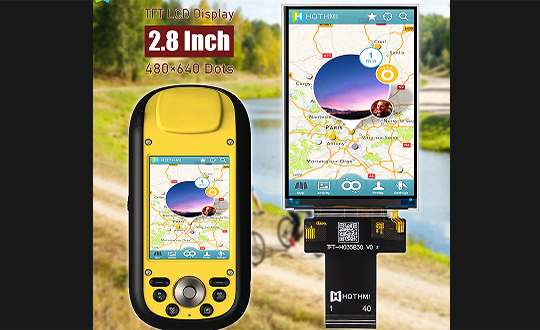
For small-size TFT LCD Display products such as 2.4-inch, 2.8-inch, and 3.5-inch models, SPI can reduce GPIO usage.
However, SPI has limited serial data bandwidth. As resolution, refresh rate, and color depth increase, SPI may become a limitation on display refresh speed.
RGB Interface
The RGB interface transmits pixel data in parallel and is commonly used in industrial control and embedded display systems.Engineers need to confirm:
- RGB565 / RGB666 / RGB888
- PCLK
- HSYNC
- VSYNC
- DE
- Pixel Clock
- Data Width
For MCUs or MPUs with an RGB LCD Controller such as STM32 LTDC, an RGB interface can directly match the parallel display output of the main controller.
MIPI DSI
MIPI DSI is suitable for embedded systems that require higher display bandwidth while reducing the number of high-speed signal lines.Common configurations include:
- 1-Lane
- 2-Lane
- 4-Lane
Higher-resolution TFT LCD Display products such as 8-inch 1920×1200 models generally require greater data transmission capability, and MIPI DSI can be used for these systems.
When using MIPI DSI, engineers need to confirm the MIPI DSI specifications of the main controller, Lane count, output clock, supported resolution, and Panel initialization program.
LVDS
LVDS is commonly used for larger displays or display systems requiring high-speed and stable data transmission.Engineers need to confirm:
- Single LVDS / Dual LVDS
- Lane count
- Data Mapping
- Pixel Clock
- Connector Pin Definition
If the mainboard has already been designed with LVDS output, the selected TFT LCD Display needs to match the electrical specifications and timing requirements.
HI, VGA, and eDP
HI is suitable for receiving standard video signals directly and can be convenient for development boards, industrial control equipment, and some Raspberry Pi projects.
VGA is still used in some industrial equipment and legacy system upgrades.
eDP is more commonly used in high-resolution computing devices and industrial computing platforms.
When choosing an interface, the key consideration is not whether the interface itself is more advanced, but whether it matches the main controller output, software driver, PCB design, and target resolution.
If you need to compare different Display Interface options in more detail, you can refer to HOTHMI’s Display Interface selection content.
How Much Brightness Does a TFT LCD Display Need?
Brightness is generally specified in cd/m², also known as nits.
For indoor equipment, 300-500 cd/m² can be used as an initial evaluation range. Bright indoor environments or semi-outdoor applications may require 500-800 cd/m². Outdoor equipment generally requires 800 cd/m² or higher, while devices directly exposed to sunlight may require 1000-1500 cd/m² or even higher.
A simple engineering reference is:
| Usage Environment | Brightness Range to Consider |
|---|---|
| Normal Indoor | 300-500 cd/m² |
| Bright Indoor | 500-800 cd/m² |
| Semi-Outdoor | 800-1000 cd/m² |
| Outdoor | 1000 cd/m² and above |
These values are only initial reference ranges. The final selection should also consider actual lighting conditions.
High brightness does not necessarily mean complete sunlight readability.
An Outdoor TFT LCD Display also needs to be evaluated for:
- Contrast Ratio
- Polarizer
- Viewing Angle
- Anti-Glare (AG)
- Anti-Reflection (AR)
- Optical Bonding
- Cover Glass Reflectivity
If the device needs to operate under strong sunlight, brightness should be evaluated together with the optical structure rather than comparing cd/m² values alone.
How to Determine the Operating Temperature of a TFT LCD Display?
The operating temperature should be determined according to the actual installation environment of the device.
Normal indoor equipment may only require a relatively narrow operating temperature range, while industrial, automotive, and outdoor equipment generally requires a wider temperature specification.Common ranges include:
- 0-50°C
- -20-70°C
- -30-80°C
- -30-85°C
For a TFT LCD Display installed inside an outdoor control cabinet, engineers need to consider low temperatures in winter and temperature increases inside the cabinet during summer. For displays installed in vehicles or inside equipment, the required specification should also be determined based on the temperature test results of the complete system.
In addition to Operating Temperature, it is also recommended to confirm:
- Storage Temperature
- Backlight Lifetime
- Startup Behavior at Low Temperature
- Touch Performance at Low Temperature
- Temperature-Related Brightness Changes
If a device needs to operate continuously in a -30 to 80°C environment, it is not sufficient to choose a standard-temperature TFT LCD Display and rely only on system-level heat dissipation. The temperature specification of the Panel itself needs to meet the system requirements.
Why Is the Driver IC Important When Selecting a TFT LCD Display?
The Driver IC controls LCD pixel data and display timing. Different TFT LCD products may use different controllers, such as ST7789, ST7796, ST7703, ST7701S, and GC9A01.The Driver IC can affect:
- Supported resolution
- Display interface
- Pixel format
- Initialization sequence
- Refresh method
- Certain display functions
- Software development workload
When engineers need to replace a TFT LCD Display with the same size and resolution, the original initialization code may not work directly if the new and old products use different Driver ICs.
When evaluating alternative products, it is recommended to confirm at least:
Panel Resolution + Interface + Driver IC + Initialization Requirement
How to Choose a TFT LCD Display for Different Applications?
Different devices have different priorities when selecting display parameters.
| Application | Key Parameters to Consider |
|---|---|
| Industrial HMI | Wide Temperature, Touch, Brightness, Interface |
| Medical Equipment | Viewing Angle, Brightness, Touch, Color Performance |
| Automotive | Wide Temperature, Brightness, Interface, Reliability |
| Outdoor Equipment | High Brightness, AR/AG, Wide Temperature |
| Raspberry Pi | MIPI DSI, HDMI, Resolution, Driver Support |
| POS Equipment | Touch, Viewing Angle, Brightness, Size |
| Consumer Device | Resolution, Touch, Appearance, Viewing Angle |
Industrial HMIs typically require a 7- to 10.1-inch display area, 800×480 or 1024×600 and above resolution, and an operating temperature range of -20 to 70°C or wider depending on the installation environment.
Outdoor instruments place greater emphasis on brightness of 800-1500 cd/m² or even higher, while AR, AG, Optical Bonding, and wide-temperature design also need to be considered.
For Raspberry Pi projects, the display interface and software support need to be confirmed. If MIPI DSI is used, the specific development board’s MIPI interface specifications should be checked. If HDMI is used, the supported resolution and video output format also need to be confirmed.
Technical FAQ
Q1. How do I match a TFT LCD Display interface with my MCU or processor?
First, confirm the Display Controller and output interface of the main controller. Then check the data width, timing, Lane count, Pixel Clock, and Driver IC requirements of the TFT LCD Display. For MCUs such as STM32, engineers need to confirm whether the chip supports display interfaces such as RGB and 8080. For Linux-based MPUs or SBCs, the hardware and software support for MIPI DSI, LVDS, HDMI, and other interfaces should also be checked.
Q2. How much brightness does an outdoor TFT LCD Display need?
Outdoor equipment typically requires 800 cd/m² or higher, while strong sunlight environments may require 1000-1500 cd/m² or more. However, the actual requirement also depends on Contrast Ratio, Polarizer, AR/AG, Cover Glass, and Optical Bonding. Increasing backlight brightness alone cannot solve every outdoor visibility problem.
Q3. How do I choose between SPI, MCU, RGB, MIPI, and LVDS?
The selection can be based on the main controller’s output capability, resolution, refresh rate, PCB resources, and system bandwidth. SPI is suitable for smaller displays and lower data volumes; MCU interfaces are suitable for embedded HMIs controlled by microcontrollers; RGB is suitable for MCUs/MPUs that support parallel LCD output; MIPI DSI is suitable for higher-resolution and high-bandwidth embedded systems; and LVDS is commonly used in larger displays or high-speed display systems.
Q4. When should I choose a customized TFT LCD Display?
Customization can be considered when standard products cannot meet requirements for size, FPC, Connector, Touch Panel, Brightness, Temperature, or mechanical installation. For products intended for long-term mass production, it is also recommended to confirm the FPC, Driver IC, touch solution, and supply cycle at the early project stage to reduce the cost of later changes.
HOTHMI Custom TFT LCD Display Support
TFT LCD Display selection needs to consider display performance, electrical interface, mechanical structure, and the actual operating environment. If an existing standard product cannot fully meet the project requirements, HOTHMI can provide customization support based on requirements such as size, resolution, interface, brightness, touch, FPC, Connector, operating temperature, and optical structure.