How Is a Liquid Crystal Display Constructed?
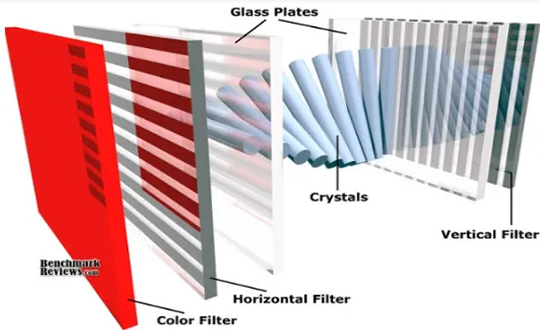
Structurally speaking, liquid crystal display devices are a type of flat-panel display, and their basic structure is flat. The basic construction of all liquid crystal display devices can be understood as consisting of two substrates,the surfaces of the substrates undergo photolithography to form transparent conductive electrodes, with a layer of liquid crystal filled between them; the assembly is then sealed to form a flat enclosure. If the product requires a polarizing film, it is bonded to the outer surface of the conductive glass. Common TN-type LCDs consist primarily of polarizing films, front glass, sealing edges, and back glass; refer to Figure 1 for the specific structure.
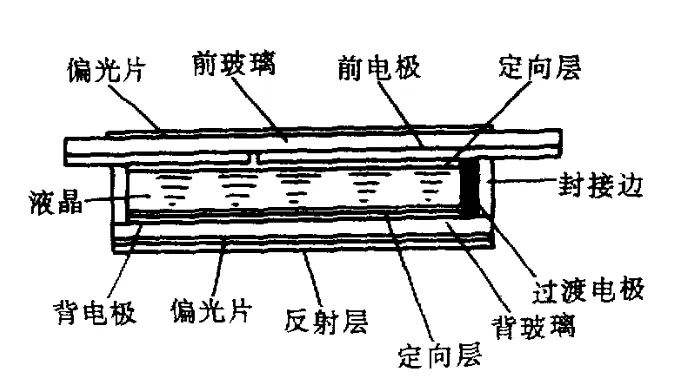
Two flat glass plates, each with photolithographically patterned transparent conductive electrodes, are placed facing each other, with the gap between them controlled at 6–7 µm. The perimeter of the device is sealed with epoxy adhesive, and one side of the seal is left with an opening—known as the liquid crystal injection port—through which the liquid crystal material is injected under vacuum. After injection, the injection port is sealed with resin. Subsequently, front and rear polarizing films are laminated onto the front and back surfaces of the liquid crystal cell in an orthogonal orientation, thereby completing a fully assembled liquid crystal display device.
A liquid crystal display device primarily consists of three basic components: glass substrates, liquid crystal material, and polarizing films. The following provides a brief introduction to the use of these three basic components.
Glass Substrate
The surface of the glass substrate is extremely flat; it is a thin sheet of glass produced using the float glass process. A transparent conductive layer—specifically an indium oxide (In₂O₃) or tin dioxide (SnO₂) layer, known as an ITO film—is vapor-deposited onto its surface. Transparent conductive patterns are then formed through photolithography. These patterns consist of two parts: pixel patterns and external lead patterns. Therefore, external leads cannot be soldered using traditional tin-soldering methods but must be connected using materials such as conductive rubber strips or conductive tape. If scratched, cut, or corroded, the device will be rendered immediately unusable.
Liquid Crystal Material
Liquid crystal material is the core component of liquid crystal display devices, and different devices use different types of liquid crystal materials. Most liquid crystals are formulated by blending several or even dozens of individual liquid crystal monomers, each of which has a specific clear point and crystallization point T. Consequently, liquid crystal display devices must be used and stored within a specific temperature range. If the operating or storage temperature is too low, the liquid crystal will crystallize, damaging the device’s alignment layer; if the temperature is too high, the liquid crystal will lose its liquid-crystal state, and the device will cease to function as a display.
Polarizing Film
Polarizing film, also known as a polarizer, is made of plastic film material. Its surface is coated with an optically sensitive adhesive that allows it to be bonded to the surface of the LCD panel. The front polarizing film comes with a protective film that must be peeled off before use. Polarizing film is not resistant to high-temperature or high-humidity environments; prolonged exposure to such conditions can easily lead to bubbling and a decline in polarization performance.
The views expressed in this article were first published on the company’s official website.