Analysis of Characteristic Differences Among Common LCD Display Modes (TN/STN/FSTN/VA)
Liquid crystal displays have become deeply integrated into a wide variety of everyday electronic devices. As a major branch of display technology, LCDs (liquid crystal displays) can be categorized into three types based on driving architecture: static drive, passive matrix drive, and active matrix drive. Furthermore, based on the different twist angles of liquid crystal molecules within the cell, multiple operating modes can be derived, each with distinct visual performance characteristics.
TN (Twisted Nematic) technology emerged after DSM liquid crystal materials and is regarded as the cornerstone of the modern LCD industry. Subsequently developed solutions such as HTN, STN, FSTN, and DFSTN are all evolutionary variants based on TN principles. Their core differences primarily lie in the alignment of liquid crystal molecules, twist angles, and associated circuit designs.
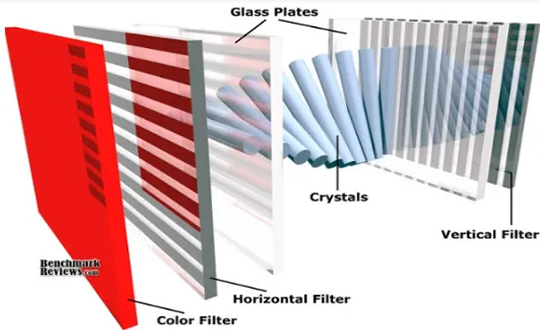
Structurally, TN, HTN, STN, FSTN, and DFSTN are highly similar, but their twist angles differ significantly: TN has a standard 90° twist, HTN ranges from 90° to 120°, while STN reaches 180° to 270°. FSTN and DFSTN are essentially still within the STN family, achieving different optical characteristics merely by adjusting the twist angle and polarizer angles. For example, STN screens commonly come in various background colors such as yellow-green, blue, and gray, whereas TN screens are divided into positive and negative display modes. FSTN and DFSTN typically present a black-and-white appearance—FSTN relies on film compensation technology, while DFSTN employs a dual-layer structure to optimize black-and-white rendering.
VA (Vertical Alignment) liquid crystals are characterized by the fact that, in the absence of an electric field, the long axes of the molecules are aligned perpendicular to the glass substrate surface. This orientation mechanism gives them a distinct contrast advantage.
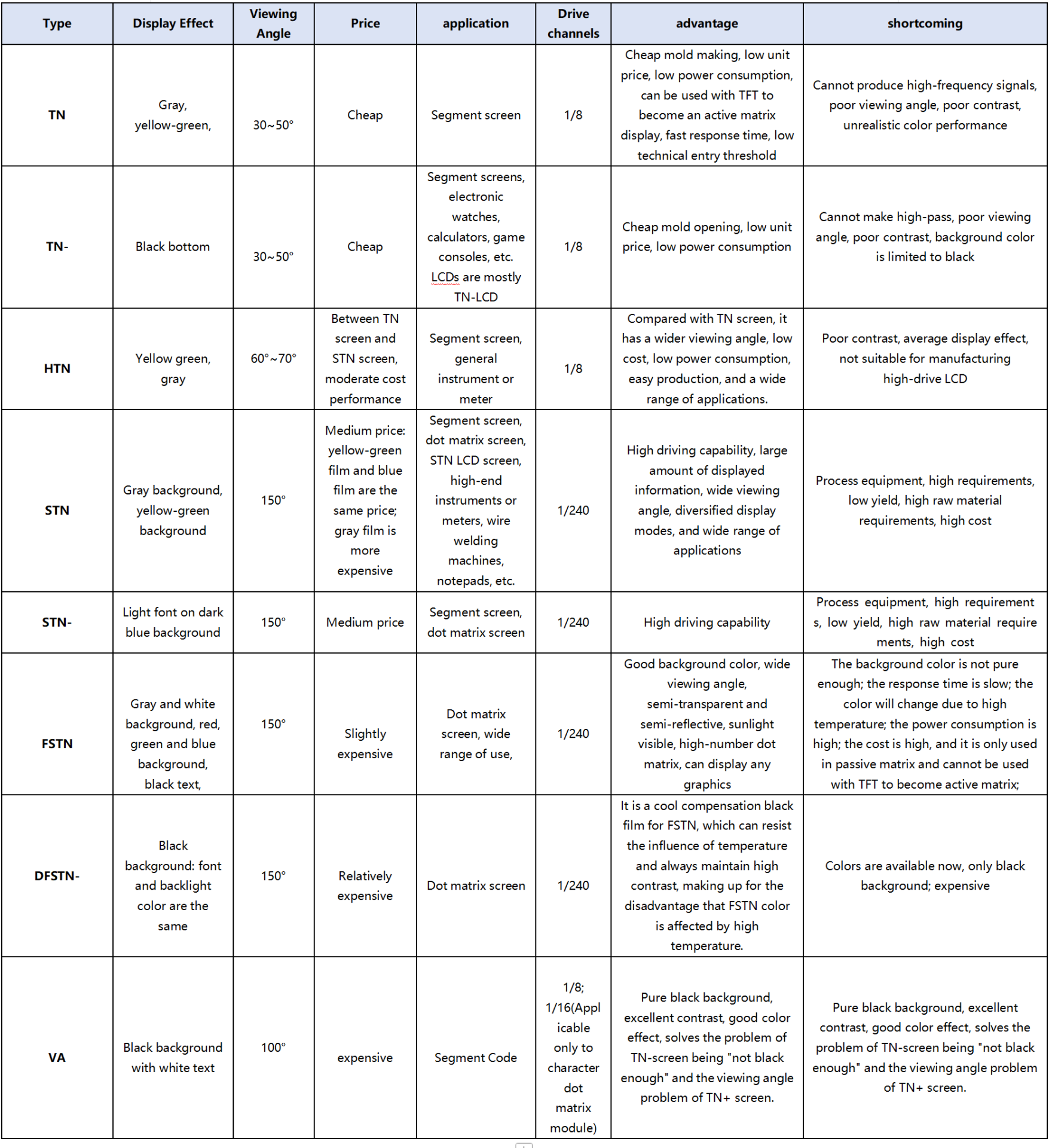
The following table systematically compares the performance differences of each mode across multiple dimensions:
Viewing angle progression:
TN < HTN < VA < STN ≈ FSTN (including DFSTN-)
Explanation of Positive and Negative Display Modes for LCD:
- Positive Display (Positive Mode): Mostly uses transflective polarizers, does not rely on backlighting, operates at lower voltage and power consumption, and has good environmental adaptability.
- Negative Display (Negative Mode): Requires transmissive polarizers and a backlight source, and the backlight brightness typically needs to reach 800 nits or above to ensure visibility under strong outdoor light.
Response speed ranking by mode:
TN > HTN > STN > FSTN > VA
Contrast ranking by mode:
VA > FSTN (DFSTN-) > STN > HTN > TN
Note: The above content is merely a summary of technical characteristics. In actual selection, comprehensive evaluation should be conducted based on specific application requirements.