Description
Product Detailed Introduction
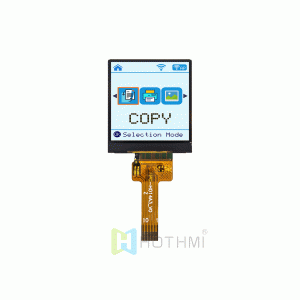
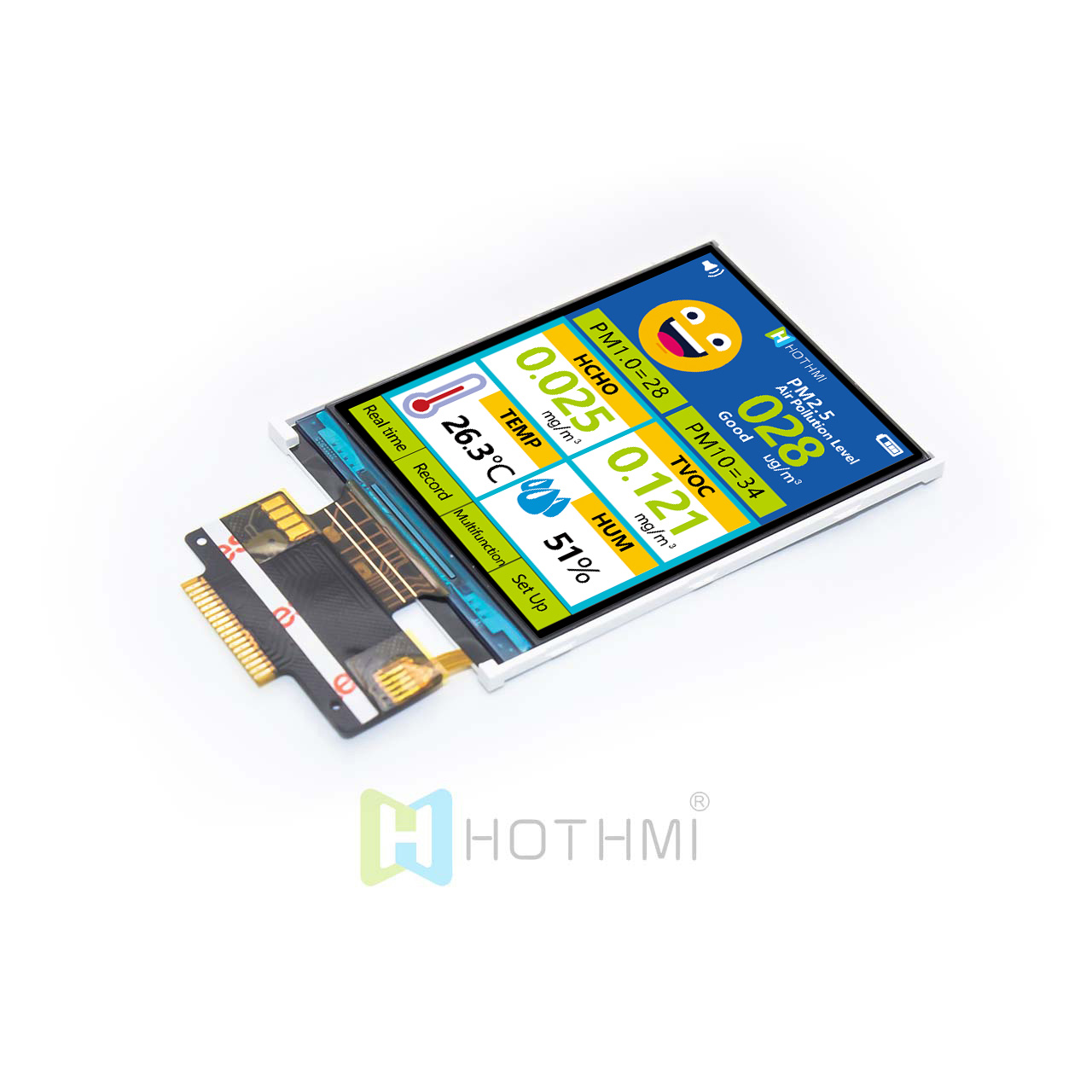
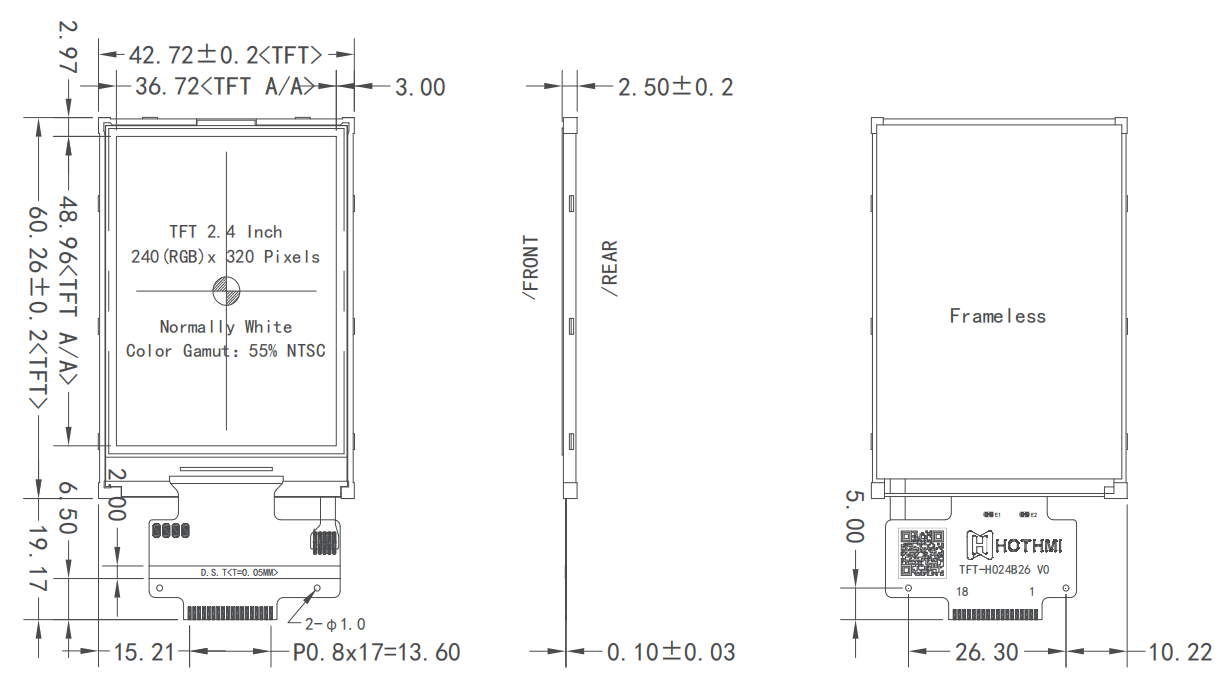
This 2.4-inch SPI TFT LCD Display module (model: TFT-H024B26QVTST4N18), designed by HOTHMI, features a compact frameless design with a resolution of 240(RGB)×320 pixels and 55% NTSC color gamut with Normally White display characteristics. The overall display panel area measures 36.72×48.96mm.
Technically, the module operates at a supply voltage of 2.8 to 3.3V, integrates the ST7789 driver IC, and uses a 4-wire 8-bit serial interface for efficient signal transmission. In terms of environmental resilience, its operating temperature ranges from -20℃ to +70℃, with storage temperature extending from -30℃ to +80℃. The backlight driving conditions are VF=3.0~3.4V and If=80mA, delivering a typical high brightness of 450 cd/m², making it suitable for various industrial equipment that requires clear visual display and stable data interaction.
Core Product Highlights of SPI TFT LCD Display
High-Speed SPI Serial Interface
Traditional parallel interface screens require up to 8–16 data lines and several control lines. In contrast, this SPI TFT LCD Display needs only 4 core signal lines to achieve full screen refresh, which not only greatly simplifies PCB routing but also maintains perfect compatibility with various pin-constrained, low-power microcontrollers (such as ESP32, STM32, Arduino, etc.).
Industrial-Grade Robustness
With a typical brightness of 450 cd/m² and an operating temperature range of -20℃ to +70℃ (storage up to -80℃), this module performs reliably in extreme cold outdoor environments in northern winters as well as in high-temperature enclosed spaces inside industrial equipment, ensuring consistent display lifespan and response speed.
Multiple Touch Options for Diverse Interaction Needs
To meet varied interactive requirements, this series offers highly flexible customization options. Users can choose between non-touch, capacitive touch, or resistive touch screens based on project budget and application environment.
Frameless Lightweight Aesthetic Design
By eliminating the traditional bulky metal bezel, the frameless design allows for a more natural edge transition, helping end devices achieve a “full-screen” or seamlessly integrated visual aesthetic.
Pin Description of SPI TFT LCD Display
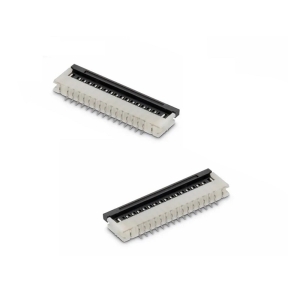
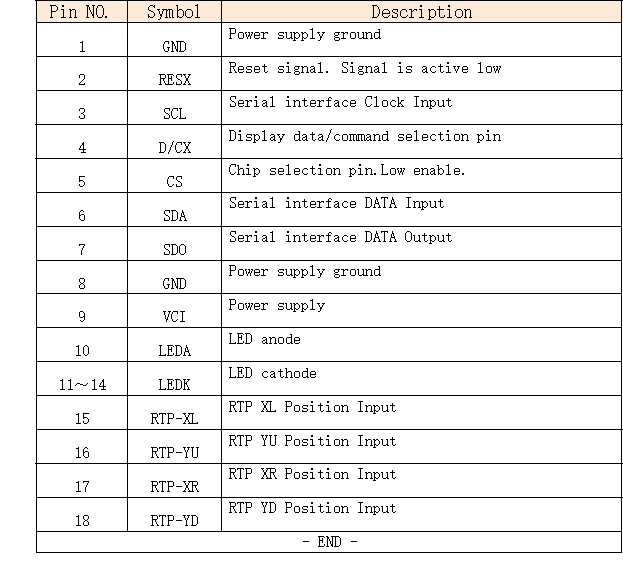
This 2.4-inch SPI TFT LCD Display module connects to the mainboard via an 18-pin flexible printed circuit with a 0.8mm pitch, suitable for soldering or plug-in connection. The detailed pin signal definitions are as follows:
Typical Application Scenarios of SPI TFT LCD Display
Thanks to its high-speed serial bus and excellent physical environmental tolerance, this 2.4-inch SPI TFT LCD Display is widely used in various intelligent vertical applications:
- Smart home control terminals: smart thermostats, wall switch panels, fingerprint lock indoor displays, and air quality monitors.
- Industrial instrumentation: handheld gas detectors, power parameter testers, and operation monitoring panels for small CNC machines.
- Medical and healthcare devices: handheld oximeters, portable ECG monitors, electronic blood pressure meters, and high-end beauty equipment.
SPI TFT LCD Display Technical Q&A
Q1: Is this 2.4-inch SPI TFT LCD screen a 3-wire SPI or 4-wire SPI? What are the differences?
A1: This screen uses what is commonly referred to as 4-wire SPI mode. In this context, “4-wire” differs slightly from standard SPI; it refers to CS, SCL, SDA, and D/CX.
4-wire SPI mode: Uses a dedicated hardware pin (D/CX) to distinctly indicate whether the current transmission on the bus is a command or pixel data.
3-wire SPI mode: Typically lacks a D/CX pin; instead, the command/data bit is embedded as the first bit of each SPI packet (i.e., 9-bit data per transfer).
The 4-wire mode aligns better with the hardware SPI controller logic of common MCUs, making driver development simpler and achieving higher refresh efficiency.
Q2: When debugging the ST7789 driver chip over SPI, why does the screen show nothing or a white screen?
A2: A white screen or no display is often caused by the following common issues. Check them one by one:
Incorrect reset timing: The ST7789 has strict power-on reset sequence requirements. The initialization code must strictly execute: pull RESX high → delay → pull RESX low → hold for at least 10ms → pull RESX high again and wait at least 120ms before sending any initialization register commands.
Excessive clock frequency: Although the ST7789 supports high data write frequencies, when using jumper wires on a breadboard for prototyping, parasitic capacitance can distort SPI signals. Try reducing the SPI clock rate to 10MHz–20MHz in software and retest.
VCI power and backlight not ready: Ensure Pin 9 is connected to a stable 2.8V–3.3V digital power supply, and the backlight pins are connected to a proper constant-current backlight driving circuit.