What is an ultra-wide temperature TFT LCD display?
Introduction to Ultra-Wide Temperature TFT Displays
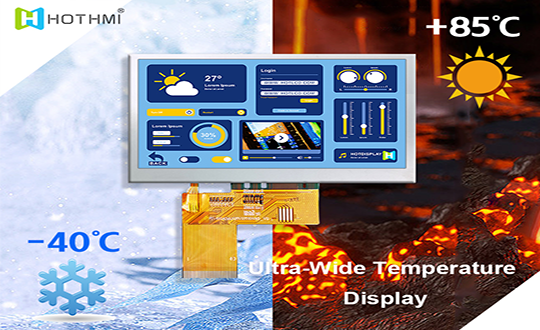
An Ultra-Wide Temperature TFT LCD display is a high-reliability display device specifically designed to maintain stable operation under extreme cold and high-temperature environments.
Standard consumer-grade displays require relatively mild operating conditions (typically operating temperatures between 0°C and 50°C). Once exposed to harsh environments, they may suffer from screen freezing, slow response, or blackout failures. Ultra-Wide Temperature TFT displays break through this limitation, with conventional operating temperature ranges reaching from -20°C to +70°C. High-end products using special process improvements can even withstand extreme temperature differences from -40°C to +90°C. Therefore, they are widely used in industrial control, military equipment, outdoor terminals, aerospace, and other demanding scenarios where high reliability is essential.
In-Depth Comparison Between Ultra-Wide Temperature TFT Displays and Standard Displays
The table below clearly shows that the investment in materials and processes for Ultra-Wide Temperature TFT LCD displays provides irreplaceable industrial value.
| Feature | Standard Display | Ultra-Wide Temperature TFT LCD Display |
| Temperature Range | 0°C to 50°C | -20°C to +70°C (High-end: -40°C to +90°C) |
| Manufacturing Cost | Lower | Higher (requires special temperature-resistant materials and complex packaging processes) |
| Service Life | Suitable only for normal indoor or standard temperature-controlled environments | Deeply optimized for harsh environments, offering longer life and very slow degradation |
| Application Scenarios | Smartphones, home appliances, and other consumer electronics | Industrial automation, military, outdoor applications, and harsh environments |
Core Conclusion: Through comprehensive upgrades to liquid crystal materials, driving circuits, and enclosure structures, Ultra-Wide Temperature TFT LCD displays can perfectly withstand severe temperature fluctuations. Although the initial investment cost is higher, their irreplaceable stability and long life in extreme environments are key to ensuring the safe operation of complete equipment.
Three Major Technical Challenges of Extreme Temperatures and Their Solutions
TFT liquid crystals undergo physical property changes in extremely cold or hot environments. The industry typically addresses these challenges through the following precision technical methods.
Overcoming Low-Temperature Freezing and Image Sticking
- Thermal Compensation Mechanism: Integrates an efficient heating film or temperature control component on the back of the LCD panel to actively raise the panel temperature and prevent liquid crystal molecules from freezing.
- Low-Viscosity Liquid Crystal Formulations: Uses advanced low-viscosity liquid crystal materials to ensure that liquid crystal molecules can still twist quickly under extremely cold conditions, significantly improving response speed.
Suppressing High-Temperature Failure and Aging
- Multi-Dimensional Heat Dissipation Structure: Employs a high-thermal-conductivity metal enclosure and adds professional heat sinks to create an efficient passive heat dissipation path.
- Special Optical Materials: Selects high-temperature-resistant polarizers and cured adhesives to prevent yellowing, bubbling, or delamination under high-temperature environments.
Resisting Rapid Temperature Changes and Physical Deformation
- Thermal Expansion/Contraction Design: Optimizes the mechanical structure of the module, providing scientific clearance for expansion stress.
- Reinforced Solder Joint Process: Uses reinforced soldering for components to prevent solder joint failure due to severe thermal cycling.
Balancing Power Consumption and High Reliability
- Energy-Efficient Circuit Optimization: Reduces the power consumption of the driving circuit and lowers the self-heating of chips.
- Rigorous Quality Screening: Must pass a series of tests including high/low temperature cycling and continuous vibration before leaving the factory.
Typical Application Scenarios
If your project or equipment falls into the following categories, it is highly recommended to select an Ultra-Wide Temperature TFT LCD display:
- Outdoor Equipment in Extremely Cold Regions: Outdoor terminals in areas where winter temperatures stay below -20°C for extended periods or in high-altitude regions.
- Environments with Strong Sunlight Exposure: Outdoor charging piles, parcel lockers, and vehicle infotainment systems where direct summer sunlight can easily cause surface temperatures to exceed 60°C due to the greenhouse effect.
- Scenarios with Rapid Temperature Fluctuations: Logistics terminals that frequently move in and out of cold storage, or vehicle dashboards that transition from a cold outdoor environment into a warm garage.
Frequently Asked Questions
Q1: Does the response time of an Ultra-Wide Temperature TFT display become slower at low temperatures?
A: Yes, it becomes slower, but the impact on an Ultra-Wide Temperature TFT display is well within a controllable range. Standard displays may black out, produce severe motion blur, or stop working entirely at low temperatures. In contrast, a genuine Ultra-Wide Temperature TFT display, through the use of low-viscosity liquid crystals and heating technology, can keep the response time at -30°C within 2 to 3 times that at standard temperatures.
Q2: What special designs do the backlight and brightness of this type of Ultra-Wide Temperature TFT display have?
A: There are two major unique advantages:
- High Brightness Option: Because these displays are often used outdoors, they are typically equipped with industrial-grade backlights offering 1000 nits or even higher brightness, ensuring anti-glare and clear visibility under strong light.
- Wide-Temperature Automatic Brightness Compensation: The module includes a built-in temperature sensor. When in a low-temperature environment, the system automatically increases the driving current to compensate for the brightness attenuation of the backlight LEDs. When in a high-temperature environment, it automatically reduces the current to lower heat generation, thereby protecting the LEDs and extending the overall lifespan of the device.