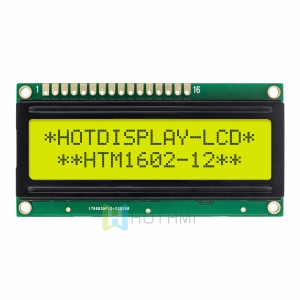
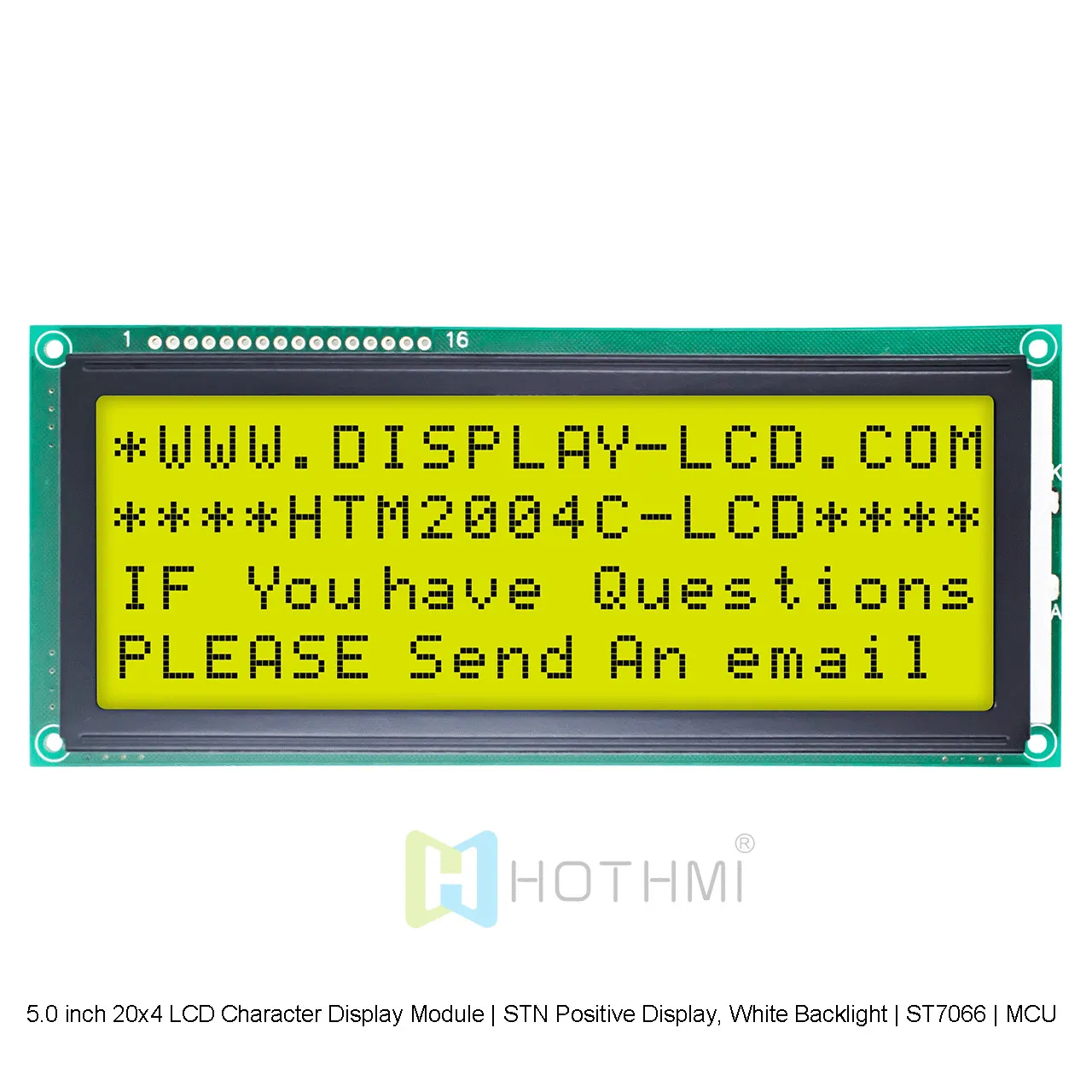
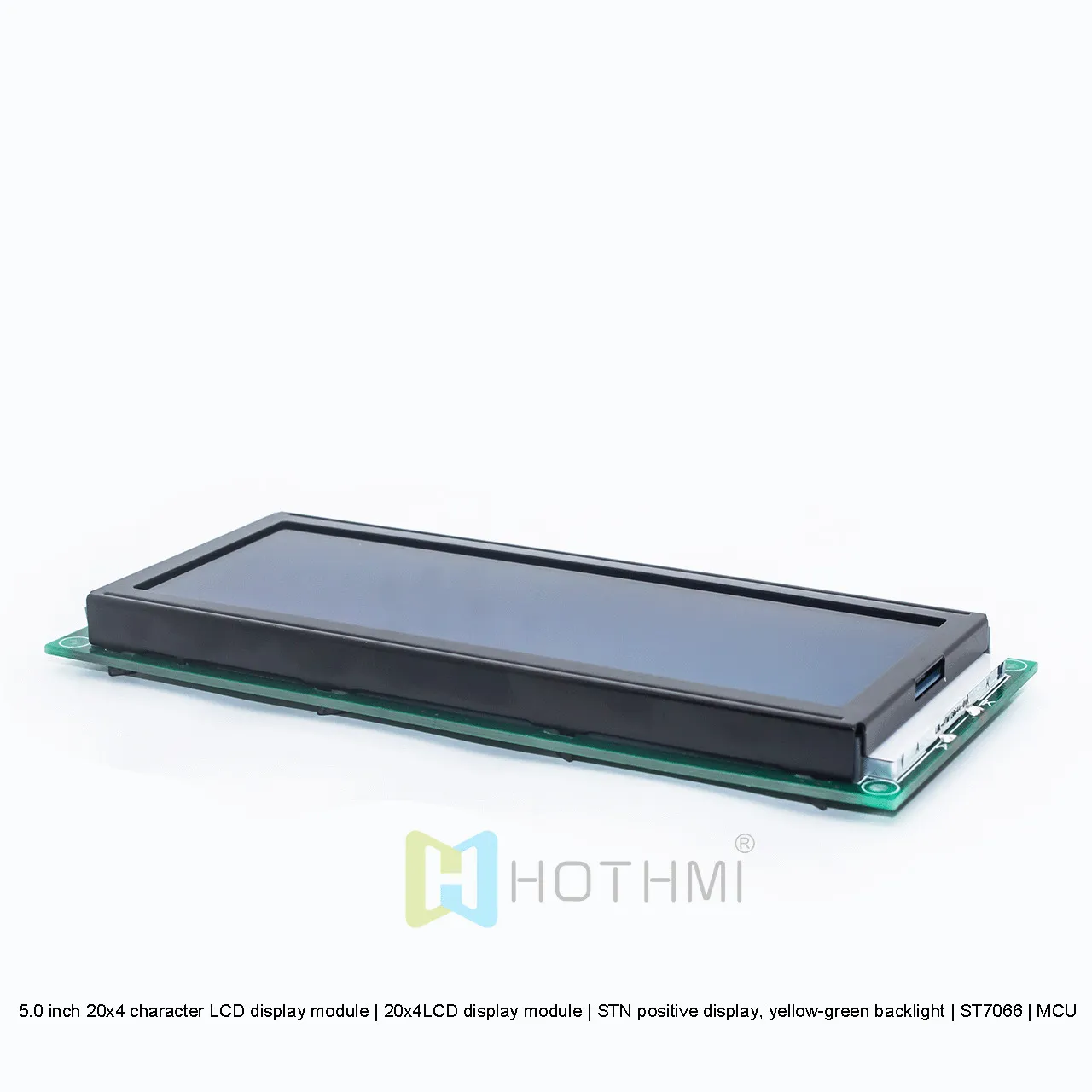
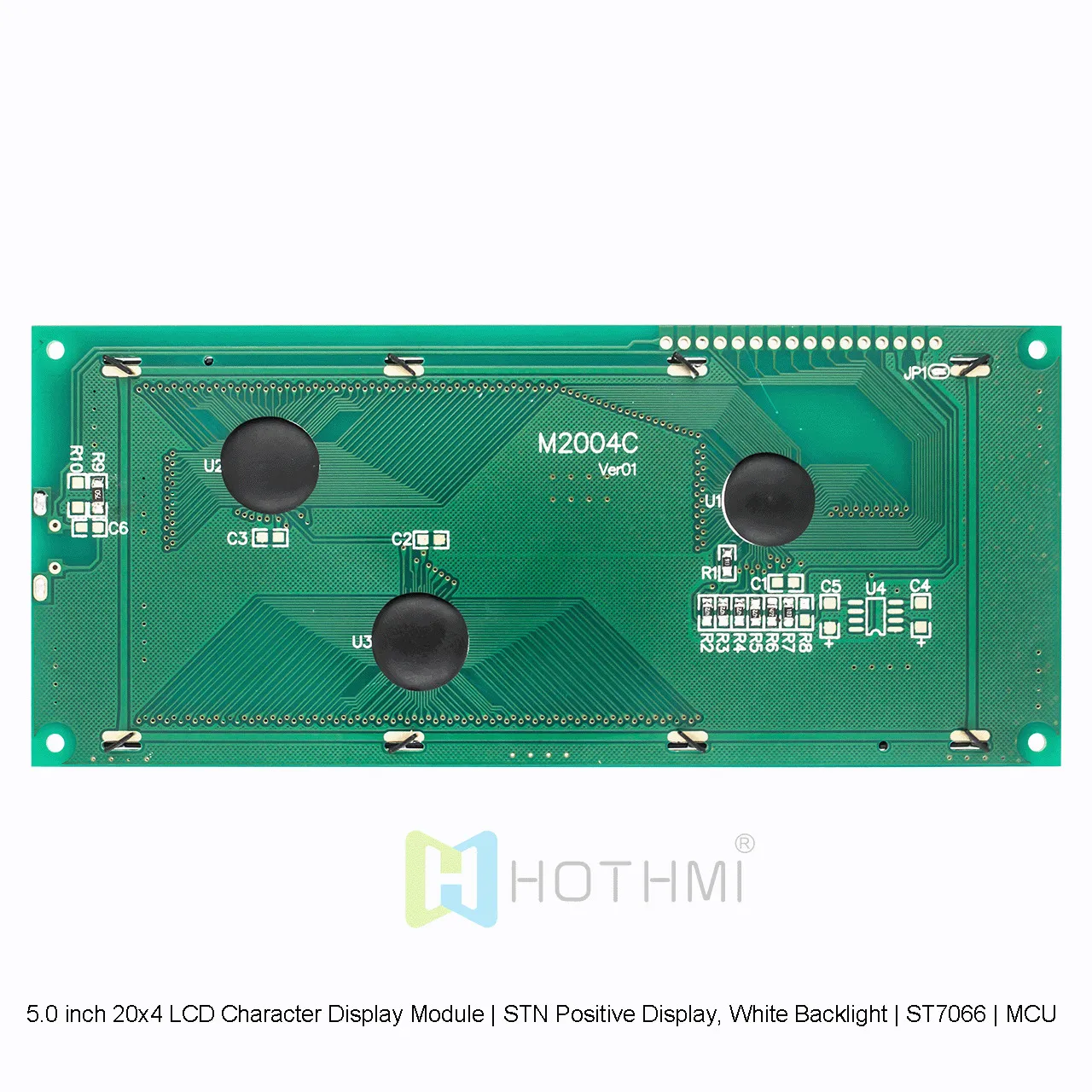
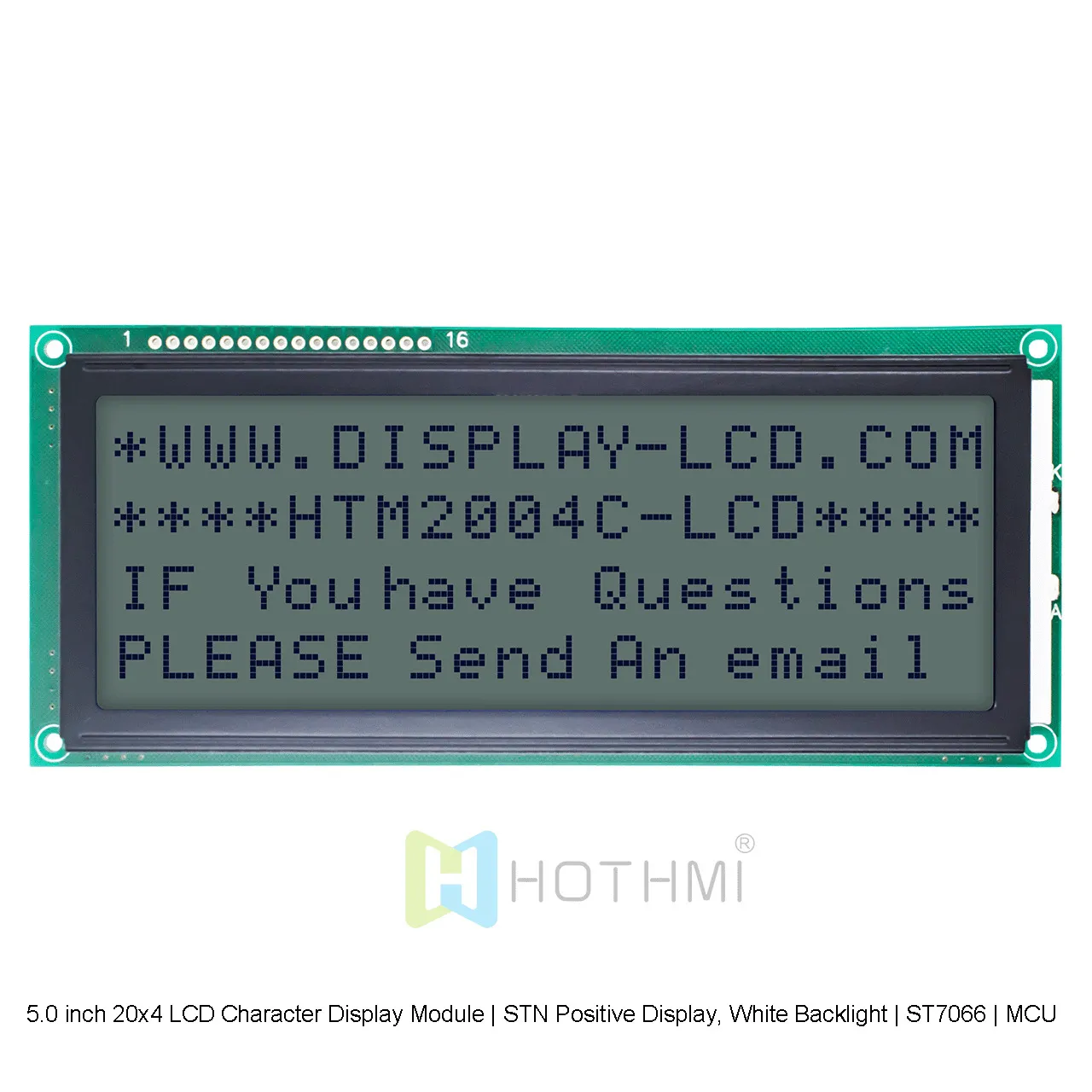
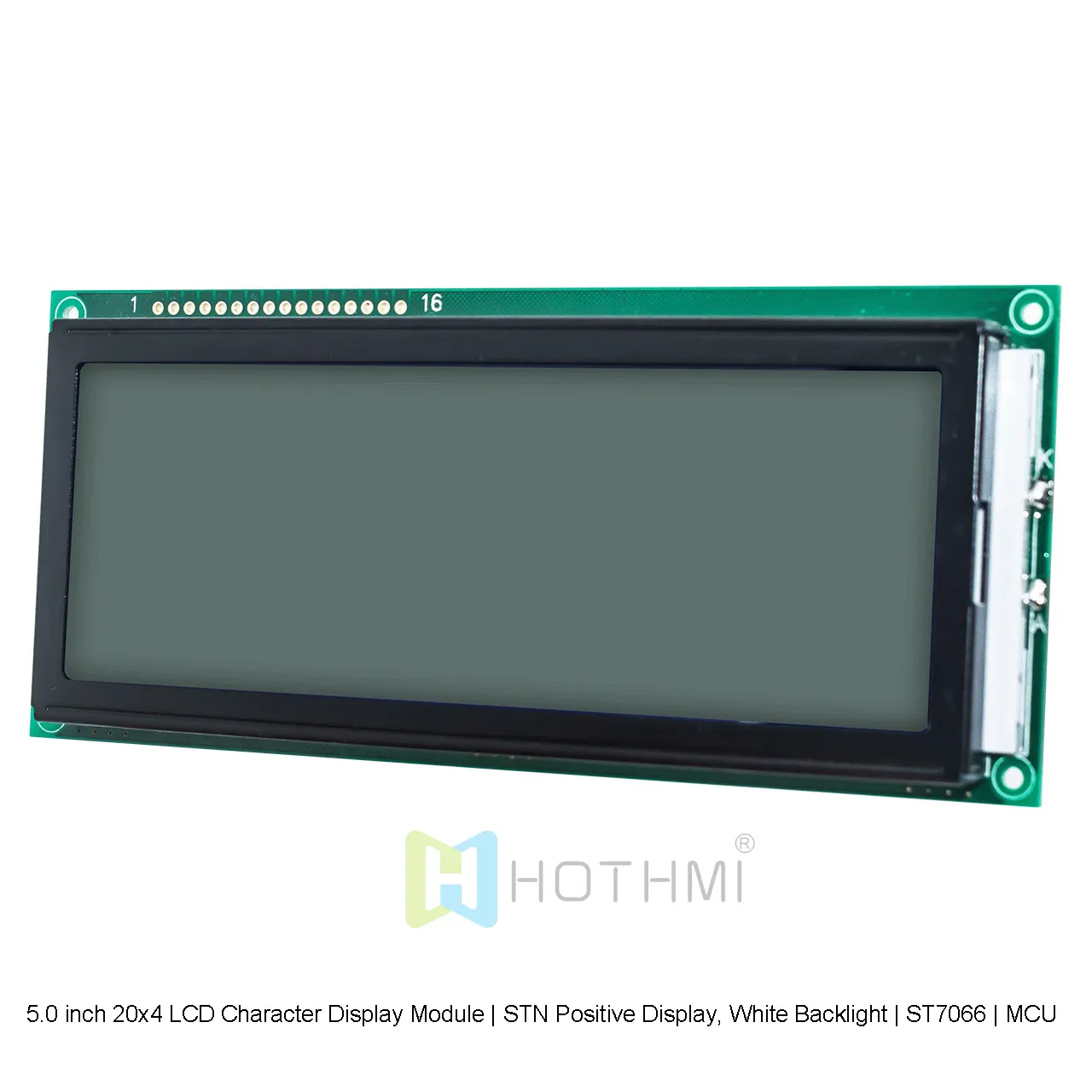
20×4 LCD Display Character LCD Modules 5V
- Model: HTM2004C-11Y
- Product type: 5.0 inch 20×4 LCD Character Modules
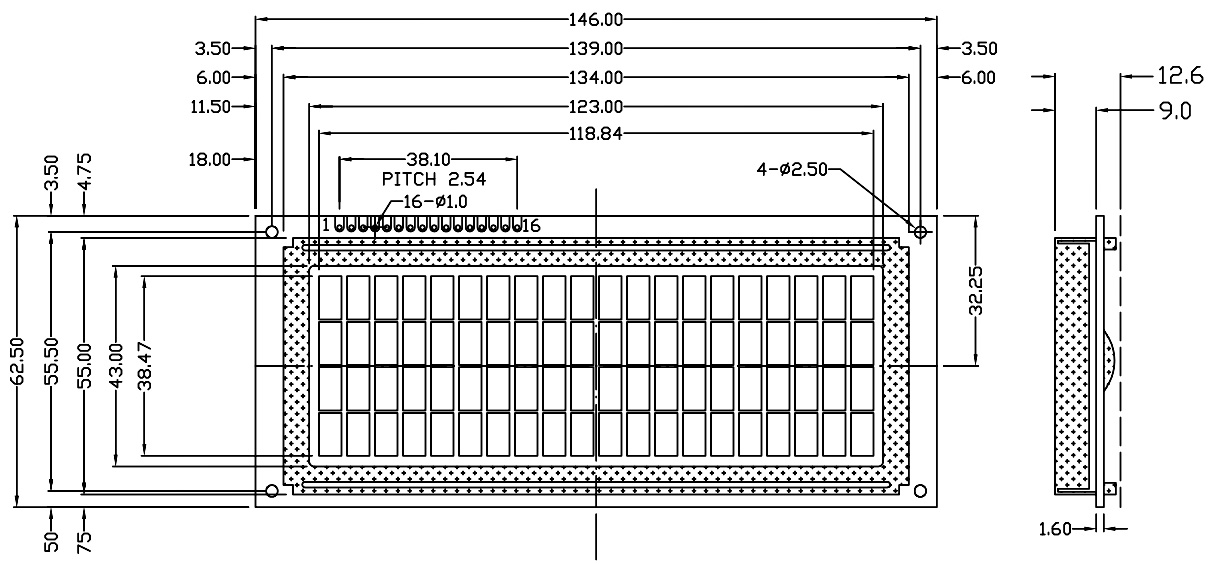
- Dimensions (mm): 146×62.5×12.6
- Viewing window size (mm): 123×43
- Operating temperature: -20~70℃
- Supply voltage: 5.0v
- Driver chip: ST7066U
$38.40
In stock
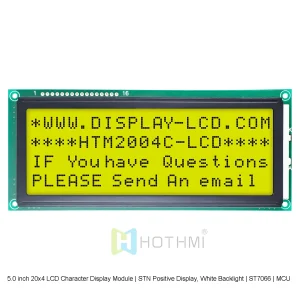
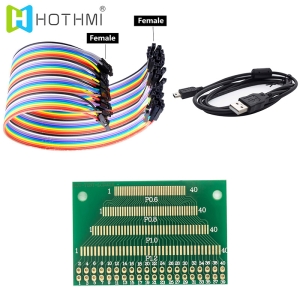
This item: 20x4 LCD Display Character LCD Modules 5V
$38.40
$38.40
Description
Product Overview: HTM-2004 Series 20×4 LCD Display Module
The 20×4 LCD Display offered by HOTHMI is a standard, high-performance character-type liquid crystal display module. 20×4 means the screen can display 4 lines of text or data, with up to 20 characters per line, allowing a single screen to show up to 80 characters.
This module uses a standard 5×8 dot matrix format (including cursor), providing clear character display. It is powered by a robust ST7066U controller (or a compatible industry-standard IC) and supports a 6800-series parallel interface, making it very easy to connect with mainstream microcontrollers such as Arduino, Raspberry Pi, STM32, and 8051.
Product Highlights: Why Choose a 20×4 LCD Display ?
- Extremely Low Power Consumption and Readability
Unlike self-emissive OLED or TFT screens, the 20×4 LCD Display is a reflective/transflective display.
Sunlight readability: Under intense direct sunlight, OLED screens often become unreadable, but the LCD 20×4 with a semi-transmissive reflective film performs exceptionally well. The brighter the ambient light, the clearer the display.
Power advantage: In battery-powered IoT devices, with the backlight turned off, the 20×4 LCD Display consumes negligible power, requiring only milliamps of current to maintain the display. This makes it ideal for portable instruments.
- Rich Visual Options
HOTHMI offers a wide range of customization options. Beyond the classic yellow-green screen commonly seen in industrial control, options include FSTN Positive (white background, black characters for high contrast) and STN Blue Negative (blue background, white characters for a more modern look).
For environments requiring night-time operation, HOTHMI provides multi-color backlight support ranging from 3.3V to 5V, including RGB full-color backlighting. This allows developers to change the screen color via PWM modulation to indicate alarms or status changes.
- Plug-and-Play Compatibility
For makers and R&D engineers, time is money. This 20×4 Character LCD is fully compatible with the standard Hitachi HD44780 protocol. This means that existing LiquidCrystal libraries (in the Arduino IDE) can drive it directly, without modifying low-level drivers. Whether for prototyping or mass production, this feature significantly shortens the development cycle.
- Rugged Durability and Wide Temperature Operation
The lifespan of consumer electronic screens is often a weak point, but the 20×4 LCD Display is designed to last over 10 years. With 8KV ESD anti-static protection and a wide temperature range of -20 to +70°C, it operates reliably in cold outdoor charging piles or hot factory production lines—environments where ordinary displays would fail.
- Characters and Custom Graphics
In addition to built-in standard ASCII codes, Japanese, and European language fonts, the 20×4 LCD Display allows users to create up to 8 custom characters. You can easily draw progress bars, special symbols (like an improved degree Celsius symbol), or simple icons, increasing the flexibility of the user interface.
Multi-Scenario Applications: The 20×4 LCD Display Empowers the Internet of Things
Industrial Automation and Control Equipment
In PLC control cabinets, variable frequency drives, servo drives, and HMI (Human-Machine Interface), the 20×4 LCD Display is a standard configuration. It can display real-time production counts, equipment operating status, and error codes. Compared to touchscreens, character LCDs are lower in cost and more stable in extreme temperatures, operating reliably in -5 degree cold or 60-degree heat found on factory floors.
Medical and Health Management
In ventilators, infusion pumps, electrocardiographs, and biochemical analyzers, data accuracy is paramount. The 20×4 LCD Module is often used to display critical patient data and equipment calibration status. Its stable display driver chip (such as the ST7066U) ensures no screen flickering or garbled characters, which is crucial for medical safety.
Consumer Electronics and Smart Home
For designers pursuing a minimalist aesthetic in Hi-Fi audio equipment (preamplifiers, DAC decoders), the 20×4 LCD Display is an excellent choice for creating a modern feel.
- Hi-Fi equipment: Displaying sampling rates (44.1kHz, 192kHz), volume levels, and input sources.
- Smart home hubs: Paired with WiFi modules like the ESP8266, it can serve as a home environmental monitoring station screen, showing real-time temperature, humidity, PM2.5 levels, time, and date.
- 3D printers and CNC machines: As an offline print control panel, it can display print progress, nozzle temperature, and heated bed temperature.
In-Depth Technical Analysis: Q&A for the 20×4 LCD Display
Q1: What advantages does a 20×4 LCD have over a 16×2 LCD besides capacity? Do I need to significantly change the software code?
Answer: Compatibility is excellent, and almost no core logic changes are required. Although the 20×4 has two more rows and four more columns than the 16×2, both are driven by the same HD44780 protocol. At the software level, the only change you need to make is to the row and column definitions during initialization.
The main advantage of the 20×4 is that it can display more parameters simultaneously. For example, showing “Temperature” and “Humidity” on a 16×2 might require scrolling. On a 20×4, you can show a system title on line 1, temperature on line 2, humidity on line 3, and air pressure on line 4 – all at a glance, without needing complex menu navigation.
Q2: My screen lights up but only shows black squares (blocks). What should I do?
Answer: This is a classic problem for beginners using a 20×4 LCD Display , often called “initialization failure.” When you see full black squares on the top row, it means the LCD’s power and contrast are functioning correctly (the circuit connection is fine), but the LCD has not received the initialization commands from the microcontroller. Here are three steps to solve it:
Check the contrast: Adjust the blue potentiometer. If the contrast is set too high, squares can appear even without data.
Check pin connections: Ensure the RW (Read/Write) pin is grounded. In most cases, we only write data to the LCD and do not need to read from it. If the RW pin is floating or pulled high, the LCD might be in “read-only” mode, refusing to accept your initialization code.
Check the reset timing: After the microcontroller resets, give the LCD enough time to prepare (usually a delay of more than 15ms). Adding delay(50); at the beginning of the setup() function in Arduino often solves this problem.
Q3: How do I choose the backlight color for my 20×4 LCD Display ? Which is best: yellow-green, white, or blue?
Answer: It depends on your usage environment and personal preference. There is no absolute best, only the most suitable.
- Yellow-Green: This is the classic industrial control color. It is visually soft, not harsh on the eyes after long periods, and provides excellent visibility in both dark environments and typical indoor lighting. Recommended for general industrial equipment.
- Blue (STN Blue Negative): This looks very modern and technological, especially with white text. Because blue light has a shorter wavelength, the character contrast is very high in low light. Recommended for consumer electronics and audio equipment. However, note that under direct sunlight, the readability of a blue film is slightly inferior to that of a yellow-green film.
- White: Very versatile, usually paired with FSTN (black and white screens), creating an effect like black text on white paper, which is extremely clear. Recommended for high-end medical or precision instruments.
Additional information
| Weight | 0.4 kg |
|---|
Attributes
| ITEM | SPECIFICATION | UNIT |
| Name | HTM-2004C-11Y | |
| Number of dots | 20 × 4 | dots |
| Module size | 146.0 x 62.5 x 12.6 (MAX) | mm |
| VA size | 123 x 43.0 | mm |
| AA size | 118.84 x 38.7 | mm |
| Pixel pitch | 0.65 x 0.7 | mm |
| IC | ST7066 | |
| Supply voltage | 5V | V |
| Backlight | Yellow-green | |
| Display mode | STN(+) | |
| Drive mode (Duty) | 1/64 duty cycle | |
| Type | Character LCD | |
| Features | Transflective |
Related products